I've been refilling liquid soap bottles for a few years now, with a method I'll describe at the end of this post. Recently, however, I heard an "eco-minute" tip on Seattle's AM 1090 which recommended taking the slivers of bath soap, adding them to an empty liquid soap bottle along with a few marbles, and filling the bottle with hot water. Shake the bottle well, and let it sit for a few days, and voila! Liquid soap.
Always looking for new ideas, I tried it. The soap created was gelatinous and difficult to pump out of the bottle, and after about a month, the pumps on all three liquid soap bottles in my house (in 1.5 baths and a kitchen) stopped working.
OK, so back to my old method! First, I use my bath soap slivers until they're gone, by rubbing them into a washcloth. So I don't really need to use them to create liquid soap; they won't go to waste in my house.
Second, here is what I do to make liquid soap. I buy foaming liquid soap dispensers, which reduce the amount of soap you use by mixing soap, water and air to create foaming bubbles. (I've just purchased 3 new bottles to replace the now useless ones! I bought Kiss My Face peace soap, made from Castile soap; an 8-oz bottle costs $2.99 at Grocery Outlet)
When the bottles are empty, I refill them with the following mixture. I buy a 24-oz. bottle of Earth Friendly Dishmate natural dish liquid at Grocery Outlet for $2.49. I use dish soap instead of liquid soap because it's very difficult to find natural liquid soap in bulk quantities. (The exception is Dr. Bonner's Castile Soap, which you can buy by the gallon. However, a gallon costs about $45).
I empty my 24-oz dish liquid into an empty gallon-sized SoftSoap refill bottle, and then fill it with warm water. Here's the secret of foaming liquid soap: the ratio of soap to water is 1:4, which makes it much more cost-effective than using a regular liquid soap dispenser. So by filling a gallon (128 oz) refill bottle with water, I achieve close to that 1:4 ratio (24:96, or 120 ounces total).
I gently shake the bottle to mix the dish soap and water and let it sit. I have found that pre-mixing the soap and letting it sit for a while produces better suds than mixing the soap and water in one of the smaller dispensers just before use. When my small dispensers are empty, I give the big bottle a gentle shake, and then refill them. I can refill three liquid soap bottles for about a year with this mixture for only $2.49, along with the initial purchase of the foaming pump dispensers.
Tuesday, April 17, 2012


Monday, April 2, 2012
Eco-cartoon for kids!
My daughter discovered a great show on Netflix: Fishtronaut, about a fish, a young girl and a monkey who solve environmental mysteries in a nature preserve in Brazil. It's actually very intelligent and informative, teaching kids about everything from the habitats and lifestyles of different animals, to recycling, to hydroelectric power. And due to my love for all things Brazilian, the show's Brazilian setting is just the icing on the cake. (Note: the show airs on Discovery Kids in the U.S., in English).
Perfect pancakes
Have you heard the joke about the woman who cut the end off her pot roast before placing it in the pan every time? When her husband questioned her about it, she couldn't explain the reason, other than that her mother used to do it. So she called her mom to ask the purpose of cutting off the end of the roast. Her mom didn't know either, except that her mother used to do it.
So the woman called her grandmother, and her grandmother explained, "I never owned a pan that was big enough to fit the whole roast."
I have a similar tale. My dad made pancakes every weekend when we were kids. At some point we started to help him, and one of the things I loved most was waiting until the pan heated up enough for a drop of water to roll around the skillet. Dad never explained why this step was necessary, however, so in my young brain I concluded that he did it because it was fun.
I followed the same technique until early in my marriage. That's when my husband freaked out about me turning on the stove beneath a skillet with nothing in it. "You should never, ever do that!" he insisted. And since I had no conscious rationale for doing so (other than the fun of watching a rolling drop of water), I stopped.
And that wasn't really a problem as long as I made pancakes in Teflon pans. When I got rid of Teflon, however, pancake-making became hit or miss for me. Sometimes I made perfect pancakes; on other occasions, they stuck to the stainless steel pan or completely burned. After more than two decades of making perfect pancakes, somehow I had become a failure at this task!
Finally, I decided that accepting my pancake failure was ridiculous, and I Googled "Pancake making in stainless steel" for help.
It turns out, my dad knew what he was doing! When you cook anything in stainless steel skillets (unless you're boiling or simmering the food in water or a sauce), you need to make sure the skillet is hot enough before you add anything (even oil) to the pan. How hot? Well, hotter than when a drop of water simply sizzles in the pan and disappears. Hot enough, in fact, for a drop of water to roll around the pan!
Only then do you add oil (if using it), and then let the oil heat a little as well (30 seconds to a minute) before adding your food. Now I am once more making perfect pancakes*, and cleanup is a cinch! And of course, since my daughter helps me now, I am trying to make sure she knows the reason for this trick.
*This works for scrambled eggs, too.
So the woman called her grandmother, and her grandmother explained, "I never owned a pan that was big enough to fit the whole roast."
I have a similar tale. My dad made pancakes every weekend when we were kids. At some point we started to help him, and one of the things I loved most was waiting until the pan heated up enough for a drop of water to roll around the skillet. Dad never explained why this step was necessary, however, so in my young brain I concluded that he did it because it was fun.
I followed the same technique until early in my marriage. That's when my husband freaked out about me turning on the stove beneath a skillet with nothing in it. "You should never, ever do that!" he insisted. And since I had no conscious rationale for doing so (other than the fun of watching a rolling drop of water), I stopped.
And that wasn't really a problem as long as I made pancakes in Teflon pans. When I got rid of Teflon, however, pancake-making became hit or miss for me. Sometimes I made perfect pancakes; on other occasions, they stuck to the stainless steel pan or completely burned. After more than two decades of making perfect pancakes, somehow I had become a failure at this task!
Finally, I decided that accepting my pancake failure was ridiculous, and I Googled "Pancake making in stainless steel" for help.
It turns out, my dad knew what he was doing! When you cook anything in stainless steel skillets (unless you're boiling or simmering the food in water or a sauce), you need to make sure the skillet is hot enough before you add anything (even oil) to the pan. How hot? Well, hotter than when a drop of water simply sizzles in the pan and disappears. Hot enough, in fact, for a drop of water to roll around the pan!
Only then do you add oil (if using it), and then let the oil heat a little as well (30 seconds to a minute) before adding your food. Now I am once more making perfect pancakes*, and cleanup is a cinch! And of course, since my daughter helps me now, I am trying to make sure she knows the reason for this trick.
*This works for scrambled eggs, too.
Tuesday, March 13, 2012
So my daughter planted a potato...
About ten days ago, my daughter was helping me peel potatoes for dinner. She noticed eyes growing on a few of them and asked me what they were. I told her that if you buried a potato, roots would grow out of the eyes and become a new potato plant.
So what did she do? She took a potato with eyes, placed it in a small container, covered it with potting soil, and watered it. Within a week, we had a plant growing that was about 4 inches tall!
Knowing this plant would soon outgrow its little pot, I called the U. Washington Master Gardeners' Program to ask them what to do with it. The woman I spoke with assured me that the hardy potato plant can definitely be transfered outdoors at this time of year. (She was delighted by my story, btw, and said she will have her granddaughter try the same thing!)
My daughter and I replanted the potato plant in a large pot on our balcony, and added additional soil around it (something the Master Gardener recommended we continue to do, because that helps potatoes grow). Last summer, we were only able to successfully grow basil and mint on our shrouded-by-large-trees (hence no sunlight) balcony. But the potato's magic happens underground. So let's see what we grow this summer! (And thank you, little one, for trying something new!)
So what did she do? She took a potato with eyes, placed it in a small container, covered it with potting soil, and watered it. Within a week, we had a plant growing that was about 4 inches tall!
Knowing this plant would soon outgrow its little pot, I called the U. Washington Master Gardeners' Program to ask them what to do with it. The woman I spoke with assured me that the hardy potato plant can definitely be transfered outdoors at this time of year. (She was delighted by my story, btw, and said she will have her granddaughter try the same thing!)
My daughter and I replanted the potato plant in a large pot on our balcony, and added additional soil around it (something the Master Gardener recommended we continue to do, because that helps potatoes grow). Last summer, we were only able to successfully grow basil and mint on our shrouded-by-large-trees (hence no sunlight) balcony. But the potato's magic happens underground. So let's see what we grow this summer! (And thank you, little one, for trying something new!)
Monday, March 5, 2012
Future vs. present tense
My blogging has dropped off tremendously... partly due to the busyness of life, but also partly due to my increased attention to current politics. I still do most of the same green things I've been doing (or have begun doing) since starting this blog, from making or buying natural health, beauty and cleaning products (except toothpaste!); to using reusables as much as possible (cloth napkins and towels, reusable menstrual products, water bottles, straws, sandwich bags, etc); to buying second-hand; to keeping the heat turned down, conserving water, and so on. But I haven't done much to seek out new or better ways to live green.
I have thought about why, and one big issue is that current political issues seem so pressing (folks are questioning whether insurance should cover birth control? Really?!), that environmental issues seem less important, or at least less urgent. Of course, that's nonsense: climate change and other environmental issues have global consequences that could potentially overshadow all other concerns.
I learned recently about the research of Dr. M. Keith Chen of Yale University. He has been examining the impact of language on cultural norms, and he has discovered something interesting: nations whose primary language has a future tense (such as English) do a poorer job of preparing for the future than nations whose primary language uses the same verb form to communicate present and future actions (such as Mandarin or German). People in countries with strong future-time-reference (FTR) languages, such as the U.S., are less likely to save for the future, eat healthily, or engage in a whole host of other behaviors that require delayed gratification in order to achieve a future payoff.
Of course, the caveat, "correlation does not equal causation" always applies. That said, the researcher is speculating about reasons for this trend. His idea is that when you use different words to communicate about the future, it's easier to see that future as separate from the present and therefore to put off future payoff actions in favor of what feels good now. Thus, when you say in English, "I will start my diet tomorrow," it's easier to put off the start of that diet than when you say in another language, "I start my diet." The latter feels more immediate, and you might thus be more likely to take action today.
I have been learning about affirmations, and the same concept applies. When you say an affirmation, you are supposed to say it in the present rather than future tense; for example, instead of saying, "I will become more patient with my child," you might say, "I am more and more patient with my child." The idea is that right now you are becoming that which you desire, even if you haven't fully arrived.
I wonder if this can apply to how we think about the environment? I have shared before that my green journey began when my daughter was a baby, because I wanted to ensure that the world would be a healthy place for her future. But maybe I should be thinking more about the here and now, and perhaps that will stimulate my urgency. In other words, today I am living in a way that makes the world a better, more healthy place right now.
What do you think?
I have thought about why, and one big issue is that current political issues seem so pressing (folks are questioning whether insurance should cover birth control? Really?!), that environmental issues seem less important, or at least less urgent. Of course, that's nonsense: climate change and other environmental issues have global consequences that could potentially overshadow all other concerns.
I learned recently about the research of Dr. M. Keith Chen of Yale University. He has been examining the impact of language on cultural norms, and he has discovered something interesting: nations whose primary language has a future tense (such as English) do a poorer job of preparing for the future than nations whose primary language uses the same verb form to communicate present and future actions (such as Mandarin or German). People in countries with strong future-time-reference (FTR) languages, such as the U.S., are less likely to save for the future, eat healthily, or engage in a whole host of other behaviors that require delayed gratification in order to achieve a future payoff.
Of course, the caveat, "correlation does not equal causation" always applies. That said, the researcher is speculating about reasons for this trend. His idea is that when you use different words to communicate about the future, it's easier to see that future as separate from the present and therefore to put off future payoff actions in favor of what feels good now. Thus, when you say in English, "I will start my diet tomorrow," it's easier to put off the start of that diet than when you say in another language, "I start my diet." The latter feels more immediate, and you might thus be more likely to take action today.
I have been learning about affirmations, and the same concept applies. When you say an affirmation, you are supposed to say it in the present rather than future tense; for example, instead of saying, "I will become more patient with my child," you might say, "I am more and more patient with my child." The idea is that right now you are becoming that which you desire, even if you haven't fully arrived.
I wonder if this can apply to how we think about the environment? I have shared before that my green journey began when my daughter was a baby, because I wanted to ensure that the world would be a healthy place for her future. But maybe I should be thinking more about the here and now, and perhaps that will stimulate my urgency. In other words, today I am living in a way that makes the world a better, more healthy place right now.
What do you think?
Friday, January 27, 2012
Great kitchen finds from Goodwill
I remember reading about planned obsolescence many years ago in an American history textbook... I was stunned to realize that someone had the audacity (in the negative sense) to deliberately create products they knew wouldn't last, just to make more money.
So when I find second-hand items that I suspect may be years, if not decades, old that still work wonderfully, I'm thrilled.
Recently I found two at Goodwill. The first is a blender. Alas, my beloved Magic Bullet has stopped working. (While it's still under extended warranty, I'm not sure I can get it replaced. Hubby didn't screw the base on tightly enough once and liquid leaked into the gears). Since I love my smoothies, I knew I needed to find another blender quickly. I made the rounds to my favorite area thrift shops, finding several blenders that seemed cheaply made and upon testing, did not work very well. Then I found this one:

While Oster still makes blenders that look very similar, it's the kitchy yellow color that makes me suspect it dates back to the 1970's. And it works beautifully! The price: $7. Compare this to Oster's new blenders with glass rather than plastic jars (this one is glass), which run about $50.
The second item is a chopper. I've had two Ronco Chop-o-Matic choppers in my life, one that I owned before my marriage, and one that my husband purchased after we were married. Each of us had been convinced to by it by what seemed to be an amazing demonstration of the product's capability at a mall kiosk. In both cases, the product failed miserably. (Note that the average review on the Amazon link gives the product 1.5 stars! And most of the manual competitors listed on the page, except for the one by the always fabulous Kitchen Aid, fare little better in customer reviews).
So what did I find recently at Goodwill? This one:

This chopper is advertised around the web as a vintage product, with a glass jar, made in the USA by Gemco. The price at Goodwill: $4, compared to about $15 elsewhere. And again, it works amazingly well!
So when I find second-hand items that I suspect may be years, if not decades, old that still work wonderfully, I'm thrilled.
Recently I found two at Goodwill. The first is a blender. Alas, my beloved Magic Bullet has stopped working. (While it's still under extended warranty, I'm not sure I can get it replaced. Hubby didn't screw the base on tightly enough once and liquid leaked into the gears). Since I love my smoothies, I knew I needed to find another blender quickly. I made the rounds to my favorite area thrift shops, finding several blenders that seemed cheaply made and upon testing, did not work very well. Then I found this one:

While Oster still makes blenders that look very similar, it's the kitchy yellow color that makes me suspect it dates back to the 1970's. And it works beautifully! The price: $7. Compare this to Oster's new blenders with glass rather than plastic jars (this one is glass), which run about $50.
The second item is a chopper. I've had two Ronco Chop-o-Matic choppers in my life, one that I owned before my marriage, and one that my husband purchased after we were married. Each of us had been convinced to by it by what seemed to be an amazing demonstration of the product's capability at a mall kiosk. In both cases, the product failed miserably. (Note that the average review on the Amazon link gives the product 1.5 stars! And most of the manual competitors listed on the page, except for the one by the always fabulous Kitchen Aid, fare little better in customer reviews).
So what did I find recently at Goodwill? This one:
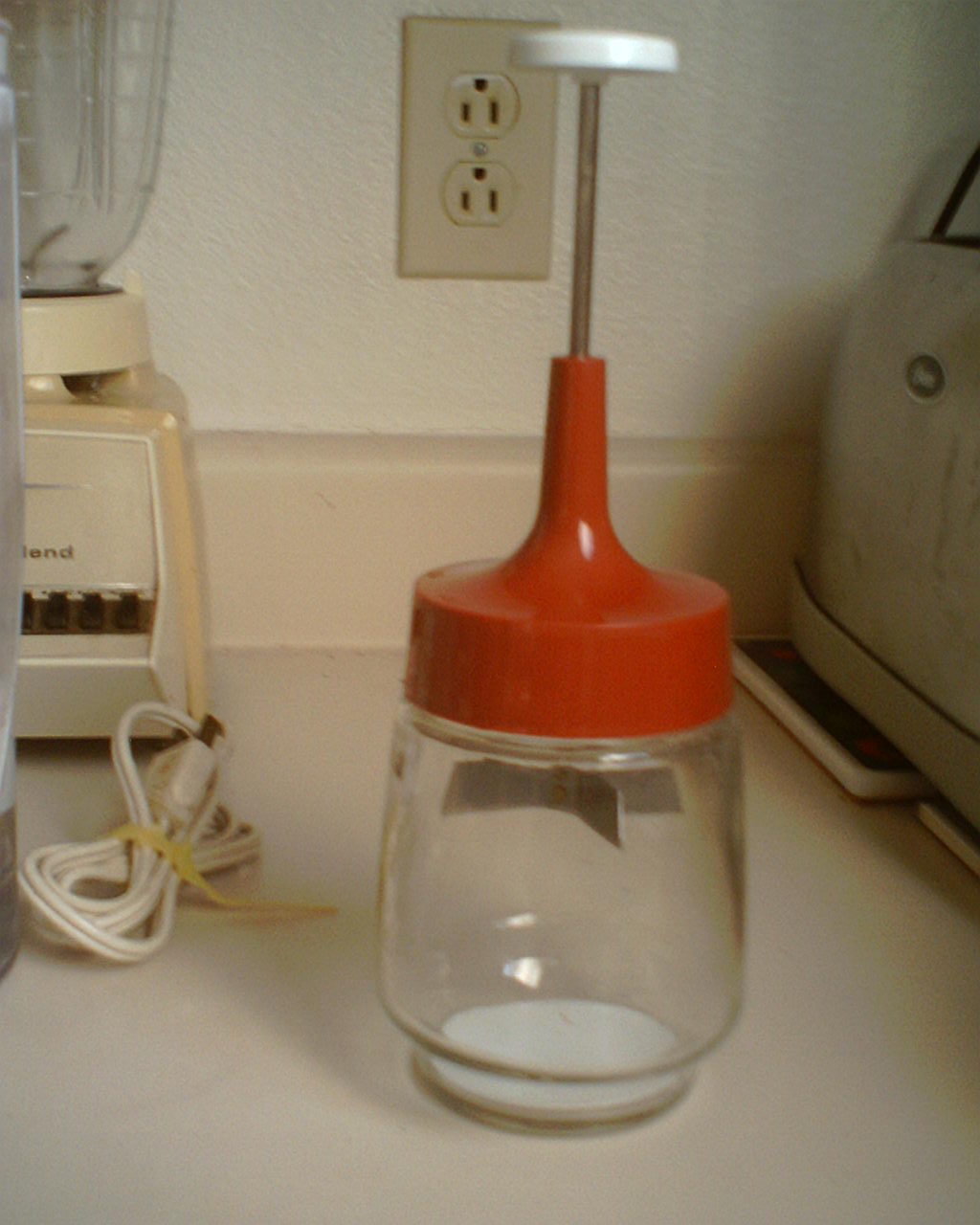
This chopper is advertised around the web as a vintage product, with a glass jar, made in the USA by Gemco. The price at Goodwill: $4, compared to about $15 elsewhere. And again, it works amazingly well!
Thursday, January 5, 2012
Reuse again... and again
I love second-hand shopping for numerous reasons, including the inexpensive prices, the ability to obtain higher quality goods that I could afford if they were new, and the fact that it's great for the environment.
For example, due to thrift shopping, my daughter received more gifts from her father and me than we could have privided her if we were buying new. We gave her a set of roller skates, a bigger bike, a boy Barbie, a dress, several cute tops and pants, and a Christmas teddy bear, all in excellent condition, for about $50 total.
Some object, however, that the second-hand market isn't practical for society at large since it always requires a first-hand market. That's true, but the complaint usually assumes a one-to-one relationship between the first-hand and second-hand market for each item. In other words, someone buys something new and donates or passes it on, then someone else gets it second-hand. Once the second person has finished with the item, that's the end of its life cycle.
Many items, however, can have multiple life cycles as long as they're still in good condition. Well-made, durable items like bikes and children's clothing (since kids tend to outgrow things quickly) can be passed on multiple times to multiple users before they're no longer in good condition.
Here's a good example: I purchased my daughter's old bike $8 from a thrift store two years ago. She has recently outgrown the bike and we found a larger one, in great condition, for $10 at Goodwill. It's very possible that either bike had multiple users (say, an older and younger sibling) before being donated and purchased by us.
One of my daughter's friends, two years older, also got a new bike for Christmas. Her mom and I planned at first to pass on both old bikes to younger children, but they were too big for the younger children we knew.
So I came up with an even better plan for passing on the two bikes. I had a meeting in Olympia today and had to pass through Lacey, where Alaffia, my favorite natural body care company, is based. Alaffia has a project, Bicycles for Education, in which they collect bikes from Washington residents to ship to Alaffia's founder's home country of Togo. These bikes make transportation to and from distant schools possible for many rural children who wouldn't otherwise be able to attend.
I dropped off both bikes at Alaffia's headquarters today and was able to have a follow-up conversation with them about hosting a bike drive at Marlene's Natural Market in Tacoma (which will take place in June). So you see, many items can be used not once, not twice, but again and again and again, for older children, younger children, and children across the world!
For example, due to thrift shopping, my daughter received more gifts from her father and me than we could have privided her if we were buying new. We gave her a set of roller skates, a bigger bike, a boy Barbie, a dress, several cute tops and pants, and a Christmas teddy bear, all in excellent condition, for about $50 total.
Some object, however, that the second-hand market isn't practical for society at large since it always requires a first-hand market. That's true, but the complaint usually assumes a one-to-one relationship between the first-hand and second-hand market for each item. In other words, someone buys something new and donates or passes it on, then someone else gets it second-hand. Once the second person has finished with the item, that's the end of its life cycle.
Many items, however, can have multiple life cycles as long as they're still in good condition. Well-made, durable items like bikes and children's clothing (since kids tend to outgrow things quickly) can be passed on multiple times to multiple users before they're no longer in good condition.
Here's a good example: I purchased my daughter's old bike $8 from a thrift store two years ago. She has recently outgrown the bike and we found a larger one, in great condition, for $10 at Goodwill. It's very possible that either bike had multiple users (say, an older and younger sibling) before being donated and purchased by us.
One of my daughter's friends, two years older, also got a new bike for Christmas. Her mom and I planned at first to pass on both old bikes to younger children, but they were too big for the younger children we knew.
So I came up with an even better plan for passing on the two bikes. I had a meeting in Olympia today and had to pass through Lacey, where Alaffia, my favorite natural body care company, is based. Alaffia has a project, Bicycles for Education, in which they collect bikes from Washington residents to ship to Alaffia's founder's home country of Togo. These bikes make transportation to and from distant schools possible for many rural children who wouldn't otherwise be able to attend.
I dropped off both bikes at Alaffia's headquarters today and was able to have a follow-up conversation with them about hosting a bike drive at Marlene's Natural Market in Tacoma (which will take place in June). So you see, many items can be used not once, not twice, but again and again and again, for older children, younger children, and children across the world!
Subscribe to:
Posts (Atom)