My blogging has dropped off tremendously... partly due to the busyness of life, but also partly due to my increased attention to current politics. I still do most of the same green things I've been doing (or have begun doing) since starting this blog, from making or buying natural health, beauty and cleaning products (except toothpaste!); to using reusables as much as possible (cloth napkins and towels, reusable menstrual products, water bottles, straws, sandwich bags, etc); to buying second-hand; to keeping the heat turned down, conserving water, and so on. But I haven't done much to seek out new or better ways to live green.
I have thought about why, and one big issue is that current political issues seem so pressing (folks are questioning whether insurance should cover birth control? Really?!), that environmental issues seem less important, or at least less urgent. Of course, that's nonsense: climate change and other environmental issues have global consequences that could potentially overshadow all other concerns.
I learned recently about the research of Dr. M. Keith Chen of Yale University. He has been examining the impact of language on cultural norms, and he has discovered something interesting: nations whose primary language has a future tense (such as English) do a poorer job of preparing for the future than nations whose primary language uses the same verb form to communicate present and future actions (such as Mandarin or German). People in countries with strong future-time-reference (FTR) languages, such as the U.S., are less likely to save for the future, eat healthily, or engage in a whole host of other behaviors that require delayed gratification in order to achieve a future payoff.
Of course, the caveat, "correlation does not equal causation" always applies. That said, the researcher is speculating about reasons for this trend. His idea is that when you use different words to communicate about the future, it's easier to see that future as separate from the present and therefore to put off future payoff actions in favor of what feels good now. Thus, when you say in English, "I will start my diet tomorrow," it's easier to put off the start of that diet than when you say in another language, "I start my diet." The latter feels more immediate, and you might thus be more likely to take action today.
I have been learning about affirmations, and the same concept applies. When you say an affirmation, you are supposed to say it in the present rather than future tense; for example, instead of saying, "I will become more patient with my child," you might say, "I am more and more patient with my child." The idea is that right now you are becoming that which you desire, even if you haven't fully arrived.
I wonder if this can apply to how we think about the environment? I have shared before that my green journey began when my daughter was a baby, because I wanted to ensure that the world would be a healthy place for her future. But maybe I should be thinking more about the here and now, and perhaps that will stimulate my urgency. In other words, today I am living in a way that makes the world a better, more healthy place right now.
What do you think?
Monday, March 5, 2012


Friday, January 27, 2012
Great kitchen finds from Goodwill
I remember reading about planned obsolescence many years ago in an American history textbook... I was stunned to realize that someone had the audacity (in the negative sense) to deliberately create products they knew wouldn't last, just to make more money.
So when I find second-hand items that I suspect may be years, if not decades, old that still work wonderfully, I'm thrilled.
Recently I found two at Goodwill. The first is a blender. Alas, my beloved Magic Bullet has stopped working. (While it's still under extended warranty, I'm not sure I can get it replaced. Hubby didn't screw the base on tightly enough once and liquid leaked into the gears). Since I love my smoothies, I knew I needed to find another blender quickly. I made the rounds to my favorite area thrift shops, finding several blenders that seemed cheaply made and upon testing, did not work very well. Then I found this one:

While Oster still makes blenders that look very similar, it's the kitchy yellow color that makes me suspect it dates back to the 1970's. And it works beautifully! The price: $7. Compare this to Oster's new blenders with glass rather than plastic jars (this one is glass), which run about $50.
The second item is a chopper. I've had two Ronco Chop-o-Matic choppers in my life, one that I owned before my marriage, and one that my husband purchased after we were married. Each of us had been convinced to by it by what seemed to be an amazing demonstration of the product's capability at a mall kiosk. In both cases, the product failed miserably. (Note that the average review on the Amazon link gives the product 1.5 stars! And most of the manual competitors listed on the page, except for the one by the always fabulous Kitchen Aid, fare little better in customer reviews).
So what did I find recently at Goodwill? This one:

This chopper is advertised around the web as a vintage product, with a glass jar, made in the USA by Gemco. The price at Goodwill: $4, compared to about $15 elsewhere. And again, it works amazingly well!
So when I find second-hand items that I suspect may be years, if not decades, old that still work wonderfully, I'm thrilled.
Recently I found two at Goodwill. The first is a blender. Alas, my beloved Magic Bullet has stopped working. (While it's still under extended warranty, I'm not sure I can get it replaced. Hubby didn't screw the base on tightly enough once and liquid leaked into the gears). Since I love my smoothies, I knew I needed to find another blender quickly. I made the rounds to my favorite area thrift shops, finding several blenders that seemed cheaply made and upon testing, did not work very well. Then I found this one:

While Oster still makes blenders that look very similar, it's the kitchy yellow color that makes me suspect it dates back to the 1970's. And it works beautifully! The price: $7. Compare this to Oster's new blenders with glass rather than plastic jars (this one is glass), which run about $50.
The second item is a chopper. I've had two Ronco Chop-o-Matic choppers in my life, one that I owned before my marriage, and one that my husband purchased after we were married. Each of us had been convinced to by it by what seemed to be an amazing demonstration of the product's capability at a mall kiosk. In both cases, the product failed miserably. (Note that the average review on the Amazon link gives the product 1.5 stars! And most of the manual competitors listed on the page, except for the one by the always fabulous Kitchen Aid, fare little better in customer reviews).
So what did I find recently at Goodwill? This one:
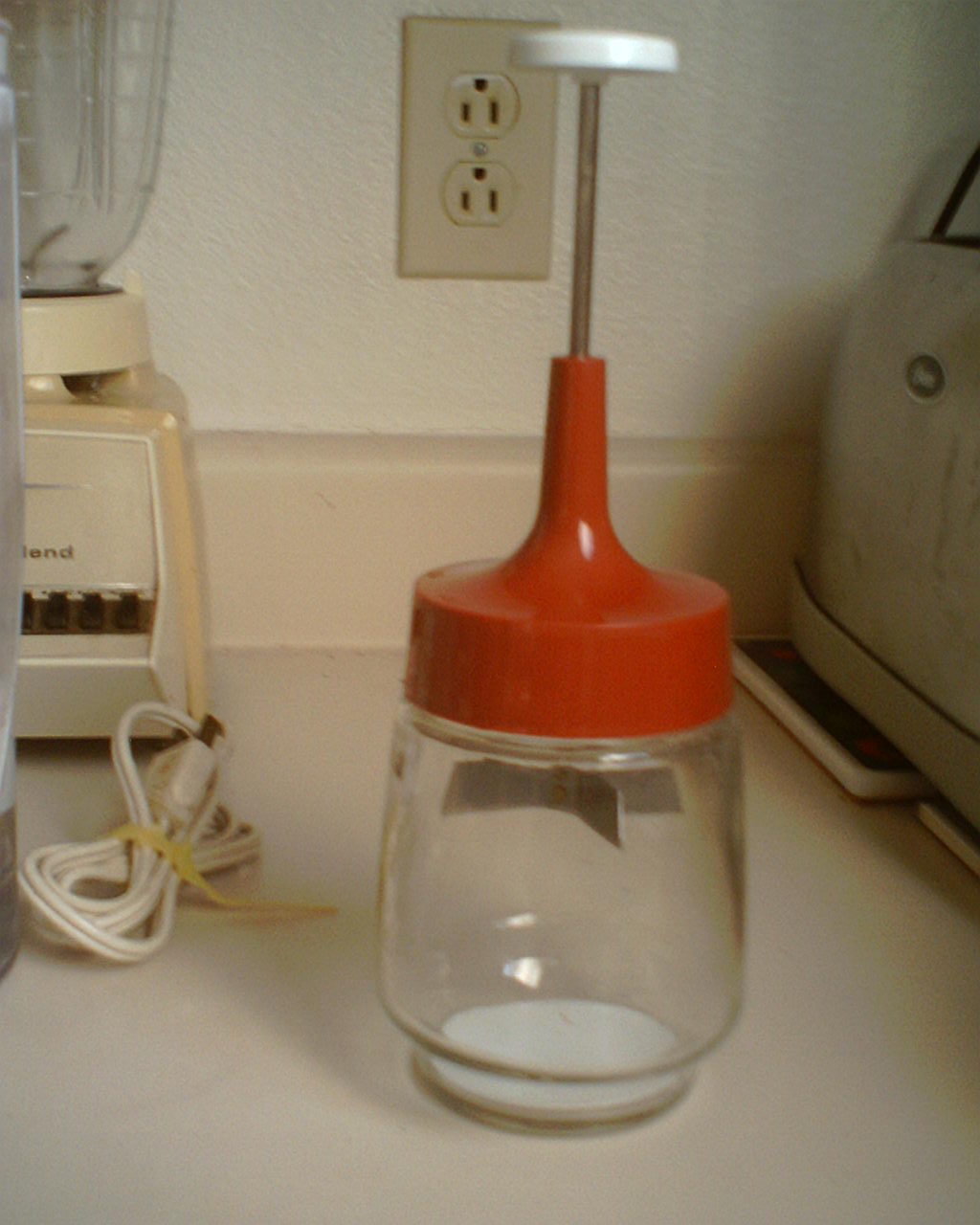
This chopper is advertised around the web as a vintage product, with a glass jar, made in the USA by Gemco. The price at Goodwill: $4, compared to about $15 elsewhere. And again, it works amazingly well!
Thursday, January 5, 2012
Reuse again... and again
I love second-hand shopping for numerous reasons, including the inexpensive prices, the ability to obtain higher quality goods that I could afford if they were new, and the fact that it's great for the environment.
For example, due to thrift shopping, my daughter received more gifts from her father and me than we could have privided her if we were buying new. We gave her a set of roller skates, a bigger bike, a boy Barbie, a dress, several cute tops and pants, and a Christmas teddy bear, all in excellent condition, for about $50 total.
Some object, however, that the second-hand market isn't practical for society at large since it always requires a first-hand market. That's true, but the complaint usually assumes a one-to-one relationship between the first-hand and second-hand market for each item. In other words, someone buys something new and donates or passes it on, then someone else gets it second-hand. Once the second person has finished with the item, that's the end of its life cycle.
Many items, however, can have multiple life cycles as long as they're still in good condition. Well-made, durable items like bikes and children's clothing (since kids tend to outgrow things quickly) can be passed on multiple times to multiple users before they're no longer in good condition.
Here's a good example: I purchased my daughter's old bike $8 from a thrift store two years ago. She has recently outgrown the bike and we found a larger one, in great condition, for $10 at Goodwill. It's very possible that either bike had multiple users (say, an older and younger sibling) before being donated and purchased by us.
One of my daughter's friends, two years older, also got a new bike for Christmas. Her mom and I planned at first to pass on both old bikes to younger children, but they were too big for the younger children we knew.
So I came up with an even better plan for passing on the two bikes. I had a meeting in Olympia today and had to pass through Lacey, where Alaffia, my favorite natural body care company, is based. Alaffia has a project, Bicycles for Education, in which they collect bikes from Washington residents to ship to Alaffia's founder's home country of Togo. These bikes make transportation to and from distant schools possible for many rural children who wouldn't otherwise be able to attend.
I dropped off both bikes at Alaffia's headquarters today and was able to have a follow-up conversation with them about hosting a bike drive at Marlene's Natural Market in Tacoma (which will take place in June). So you see, many items can be used not once, not twice, but again and again and again, for older children, younger children, and children across the world!
For example, due to thrift shopping, my daughter received more gifts from her father and me than we could have privided her if we were buying new. We gave her a set of roller skates, a bigger bike, a boy Barbie, a dress, several cute tops and pants, and a Christmas teddy bear, all in excellent condition, for about $50 total.
Some object, however, that the second-hand market isn't practical for society at large since it always requires a first-hand market. That's true, but the complaint usually assumes a one-to-one relationship between the first-hand and second-hand market for each item. In other words, someone buys something new and donates or passes it on, then someone else gets it second-hand. Once the second person has finished with the item, that's the end of its life cycle.
Many items, however, can have multiple life cycles as long as they're still in good condition. Well-made, durable items like bikes and children's clothing (since kids tend to outgrow things quickly) can be passed on multiple times to multiple users before they're no longer in good condition.
Here's a good example: I purchased my daughter's old bike $8 from a thrift store two years ago. She has recently outgrown the bike and we found a larger one, in great condition, for $10 at Goodwill. It's very possible that either bike had multiple users (say, an older and younger sibling) before being donated and purchased by us.
One of my daughter's friends, two years older, also got a new bike for Christmas. Her mom and I planned at first to pass on both old bikes to younger children, but they were too big for the younger children we knew.
So I came up with an even better plan for passing on the two bikes. I had a meeting in Olympia today and had to pass through Lacey, where Alaffia, my favorite natural body care company, is based. Alaffia has a project, Bicycles for Education, in which they collect bikes from Washington residents to ship to Alaffia's founder's home country of Togo. These bikes make transportation to and from distant schools possible for many rural children who wouldn't otherwise be able to attend.
I dropped off both bikes at Alaffia's headquarters today and was able to have a follow-up conversation with them about hosting a bike drive at Marlene's Natural Market in Tacoma (which will take place in June). So you see, many items can be used not once, not twice, but again and again and again, for older children, younger children, and children across the world!
Friday, December 9, 2011
When you're not the mom you want to be
I haven't done a lot of blogging in the last few months, mostly because I'm trying to figure out life.
I promised during the summer to write about what I was learning through a number of parenting and education books I had been reading. There were several thought-provoking ones among them, such as Po Bronson and Ashley Merryman's Nurture Shock and Ron Clark's The Excellent 11.
But the book that affected me the most was one I discovered by accident while reading a mystery novel (Lisa Gardner's Live to Tell). The novel tells the story of a group of children in a residential treatment center for kids with emotional and behavioral issues, whose families are being murdered. In the author's acknowledgements, she describes being drawn to write the story because of the experiences of a friend with such a child. She also cites Dr. Ross W. Greene's book, The Explosive Child and his "collaborative problem-solving approach," for shaping her thinking about kids with behavioral challenges and what can help them.
I found Dr. Greene's book in the library and decided to read it out of curiosity, not thinking it was really relevant to my life. My daughter's behavior isn't explosive (characterized by fits of rage, extreme tantrums and even violence). And yet, almost immediately upon starting it I knew that the book was extremely relevant to both my daughter and me.
The book establishes a key premise: that explosive children do not behave that way intentionally, because children do as well as they can. Instead, explosive children tend to lack certain skills that make less extreme emotional reactions possible. These include such things as the ability to tolerate frustration, disappointment and sudden changes; the ability to positively express and regulate one's emotions; perspective-taking and empathy; and others. When they encounter life's difficulties, they don't know how to handle it other than to explode.
The author describes his concept of collaborative problem-solving as a method in which invite your child to work through problems together, while you model and guide for your child ways to develop the personal and interpersonal skills they might be lacking.
As I read this, I knew exactly how it applied to my child and me. She doesn't explode when she's frustrated, disappointed, or struggling with her emotions; instead, she sulks and withdraws. It's not a more constructive method of handling problems, simply less destructive than exploding.
But I also realized this: I am not really equipped at this point to guide and model a different way for her, because I do the exact same thing. When I am frustrated, angry, overwhelmed or hurt, I sulk and I withdraw.
Reacting this way has had many negative effects on my family relationships, friendships, and career. I am trying to learn how to deal with it for my own sake and so that I can in turn help my daughter.
I met recently with our minister and talked through some of this. She pinpointed something about me: isolation has been a theme of my life. She's right. I have often heard that people's greatest fears are public speaking and death. I have never particularly feared either of those, but I have always feared being alone. Yet I have often felt alone, despite this fear. I am not shy, but I am reserved, and it is difficult for me to move past the acquaintance stage into true friendship with people--one of the reasons why our move to Washington State has been so difficult for me. (That is one area in which my daughter and I differ. She, like her father, is very outgoing).
It wasn't difficult for me to pinpoint the start of my isolation: something pretty awful happened to me when I was six (for a variety of reasons, I don't want to go into it online). But it seared into my psyche that I couldn't trust people to care about my needs or pain, and that it was dangerous to be vulnerable.
And that lesson took hold quickly. A year later, when I was 7, I was in a work group of four students in my class at school, and one of the other girls in the group began taunting me for reasons I don't remember. She was relentless to the point of leaving me in tears. But they were silent tears, so as not to attract the attention of our teacher. Another girl in the group went up to the teacher to ask for tissue for me. I assume the same girl later told the teacher what happened. The next morning, my teacher pulled me aside and asked, "Why didn't you tell me what was going on?"
I shrugged and didn't answer, but I was thinking, "Because you wouldn't have done anything about it." Already in second grade, I was that cynical.
I'm meeting with my minister again next week to discuss this further. But I know it's the root of my tendency to withdraw from others and myself when I'm facing problems, and my daughter is learning that from me. I want to be able to show her, and help her, discover a more positive way of dealing with difficulties.
I promised during the summer to write about what I was learning through a number of parenting and education books I had been reading. There were several thought-provoking ones among them, such as Po Bronson and Ashley Merryman's Nurture Shock and Ron Clark's The Excellent 11.
But the book that affected me the most was one I discovered by accident while reading a mystery novel (Lisa Gardner's Live to Tell). The novel tells the story of a group of children in a residential treatment center for kids with emotional and behavioral issues, whose families are being murdered. In the author's acknowledgements, she describes being drawn to write the story because of the experiences of a friend with such a child. She also cites Dr. Ross W. Greene's book, The Explosive Child and his "collaborative problem-solving approach," for shaping her thinking about kids with behavioral challenges and what can help them.
I found Dr. Greene's book in the library and decided to read it out of curiosity, not thinking it was really relevant to my life. My daughter's behavior isn't explosive (characterized by fits of rage, extreme tantrums and even violence). And yet, almost immediately upon starting it I knew that the book was extremely relevant to both my daughter and me.
The book establishes a key premise: that explosive children do not behave that way intentionally, because children do as well as they can. Instead, explosive children tend to lack certain skills that make less extreme emotional reactions possible. These include such things as the ability to tolerate frustration, disappointment and sudden changes; the ability to positively express and regulate one's emotions; perspective-taking and empathy; and others. When they encounter life's difficulties, they don't know how to handle it other than to explode.
The author describes his concept of collaborative problem-solving as a method in which invite your child to work through problems together, while you model and guide for your child ways to develop the personal and interpersonal skills they might be lacking.
As I read this, I knew exactly how it applied to my child and me. She doesn't explode when she's frustrated, disappointed, or struggling with her emotions; instead, she sulks and withdraws. It's not a more constructive method of handling problems, simply less destructive than exploding.
But I also realized this: I am not really equipped at this point to guide and model a different way for her, because I do the exact same thing. When I am frustrated, angry, overwhelmed or hurt, I sulk and I withdraw.
Reacting this way has had many negative effects on my family relationships, friendships, and career. I am trying to learn how to deal with it for my own sake and so that I can in turn help my daughter.
I met recently with our minister and talked through some of this. She pinpointed something about me: isolation has been a theme of my life. She's right. I have often heard that people's greatest fears are public speaking and death. I have never particularly feared either of those, but I have always feared being alone. Yet I have often felt alone, despite this fear. I am not shy, but I am reserved, and it is difficult for me to move past the acquaintance stage into true friendship with people--one of the reasons why our move to Washington State has been so difficult for me. (That is one area in which my daughter and I differ. She, like her father, is very outgoing).
It wasn't difficult for me to pinpoint the start of my isolation: something pretty awful happened to me when I was six (for a variety of reasons, I don't want to go into it online). But it seared into my psyche that I couldn't trust people to care about my needs or pain, and that it was dangerous to be vulnerable.
And that lesson took hold quickly. A year later, when I was 7, I was in a work group of four students in my class at school, and one of the other girls in the group began taunting me for reasons I don't remember. She was relentless to the point of leaving me in tears. But they were silent tears, so as not to attract the attention of our teacher. Another girl in the group went up to the teacher to ask for tissue for me. I assume the same girl later told the teacher what happened. The next morning, my teacher pulled me aside and asked, "Why didn't you tell me what was going on?"
I shrugged and didn't answer, but I was thinking, "Because you wouldn't have done anything about it." Already in second grade, I was that cynical.
I'm meeting with my minister again next week to discuss this further. But I know it's the root of my tendency to withdraw from others and myself when I'm facing problems, and my daughter is learning that from me. I want to be able to show her, and help her, discover a more positive way of dealing with difficulties.
Tuesday, November 15, 2011
Gabby Giffords' recovery on video--amazing!!
If you ever want to see inspiration--this is it!
Congresswoman Gabrielle Giffords, shot in the head last January. Her amazing recovery was chronicled on film by her husband, astronaut Mark Kelly.
Congresswoman Gabrielle Giffords, shot in the head last January. Her amazing recovery was chronicled on film by her husband, astronaut Mark Kelly.
Monday, October 24, 2011
Another homemade failure
Last week, I had my first-ever cavity filled.
I've always had good teeth, and in 40+ years had never had a cavity. In fact, other than having my widsom teeth pulled, I had never needed any dental care beyond routine checkups and cleanings. My husband is the same.
I know there's a lot of controversy about flouride, about its possible toxicity. I've even heard some say that flouride in our water supply and toothpastes is causing more dental problems than it solves.
I think there might be merit to the first charge (toxicity). I'm skeptical about the second. My parents had all kinds of dental problems, and I remember my mother observing that her children's better dental health was due to two things she lacked as a child: good dental care, and flouride toothpaste. I also remember reading an article in my early 20s that reported that half of American children have no cavities, a big improvement over previous generations that the article credited to flouride toothpaste and flouridated water.
In the past few years, I have tried several homemade personal care products. The products I've created for skin and hair care have worked beautifully. But two others were less successful. I gave up the first, homemade deodorant made of coconut oil, corn starch, baking soda and essential oils, because it made my underarms break out in an itchy rash.
I didn't have any immediate problems with the second, homemade toothpaste made of glycerin, baking soda, and peppermint oil. I stopped using it after a few months, however, because my teeth never felt as clean, nor my breath as fresh, as when I use conventional commercial toothpastes. I've tried a few natural toothpastes, and had the same, "they don't feel quite as clean" feeling.
In June, my family and I all had dental checkups. My daughter and my husband both had clean mouths, but I had my first cavity. I know I take better care of my teeth than either of them; my daughter is still trying to get the hang of flossing and my husband doesn't floss at all, but I floss daily. So why was I the only one to have the cavity? The only thing I can point to is the four months I went without using flouride toothpaste.
I've always had good teeth, and in 40+ years had never had a cavity. In fact, other than having my widsom teeth pulled, I had never needed any dental care beyond routine checkups and cleanings. My husband is the same.
I know there's a lot of controversy about flouride, about its possible toxicity. I've even heard some say that flouride in our water supply and toothpastes is causing more dental problems than it solves.
I think there might be merit to the first charge (toxicity). I'm skeptical about the second. My parents had all kinds of dental problems, and I remember my mother observing that her children's better dental health was due to two things she lacked as a child: good dental care, and flouride toothpaste. I also remember reading an article in my early 20s that reported that half of American children have no cavities, a big improvement over previous generations that the article credited to flouride toothpaste and flouridated water.
In the past few years, I have tried several homemade personal care products. The products I've created for skin and hair care have worked beautifully. But two others were less successful. I gave up the first, homemade deodorant made of coconut oil, corn starch, baking soda and essential oils, because it made my underarms break out in an itchy rash.
I didn't have any immediate problems with the second, homemade toothpaste made of glycerin, baking soda, and peppermint oil. I stopped using it after a few months, however, because my teeth never felt as clean, nor my breath as fresh, as when I use conventional commercial toothpastes. I've tried a few natural toothpastes, and had the same, "they don't feel quite as clean" feeling.
In June, my family and I all had dental checkups. My daughter and my husband both had clean mouths, but I had my first cavity. I know I take better care of my teeth than either of them; my daughter is still trying to get the hang of flossing and my husband doesn't floss at all, but I floss daily. So why was I the only one to have the cavity? The only thing I can point to is the four months I went without using flouride toothpaste.
Friday, September 30, 2011
How'd my summer go?
OK, I know, it's been a while since I've posted. And after my high school friend, Laura, sent me a birthday card telling me my blog was how she keeps up with my life! (Hi, Laura!)
My excuses... work has been busy, I've been getting used to apartment living, blah blah blah. (Meaning: no good excuse).
So, time to fill you in on my summer:
Still savoring? Not as much: OK, I've fallen off the wagon a few times from my "savor the sweets" diet, and have times when I indulge my sweet tooth more than I should. But still, at a doctor's appointment this week I weighed 153 lbs, down from 160 at my physical in April, so I'm making progress.
Green apartment living
We moved in May from a house to an apartment, and not long after our move, I shared about some of the "green" advantages I anticipated to apartment living. After 3 months, here is my report:
Growing our own food--a challenge: Because we moved too late in the season to start planting seeds, I bought starts. Our apartment is one of a series of buildings that surrounds a courtyard filled with large trees. Our small balcony overlooks the courtyard, and thus gets virtually no direct sunlight.
The starts I bought were for plants that can do well with little sunlight--cilantro, basil, mint, and lettuce. The basil and mint made it through the summer (but weakly), and the cilantro and lettuce didn't make it at all. I have a lot to learn about growing food in our current circumstances, so I'll try again next summer.
Composting--bokashi on the cheap: I had long heard about bokashi apartment composting. A bokashi system is an anaerobic composter--basically a bucket with a drip spout that allows you to drain off the "tea" (the liquid residue of your compost, which can be diluted and used as a fertilizer). Bokashi is a mixture of bran, molasses and microorganisms that, when added to your food scraps, accelerates their decomposition through a fermentation process. It's ideal for apartment-dwellers, because it's compact, it's an anaerobic system so fruit flies and other pests can't get into it, and because of the fermentation process, it doesn't smell. (Well, yes it does. But it smells like something fermented, rather than like rotten garbage).
A bokashi system can be expensive (about $120). But a gallon of the bokashi mixture is pretty cheap (about $15) and it lasts several months. As some experienced composters have pointed out, a bokashi system is just a bucket with a secure-fitting lid. Thus, you can do bokashi as long as you have such a bucket. I use a large container that once held ice cream served at a church social. You can also ask fast food places if you can have their left-over pickle buckets. If you're really ambitious, you can drill a hole in the bucket and add a drip spout to catch the "tea." But if you are like me, you can just add your food scraps to a Bio-bag in the bucket, and the bokashi "tea" will seep through the bag and pool in the bottom.
The challenge of using bokashi is that once the food scraps are well-fermented, you need to bury them. Once buried, the scraps decompose rapidly and supposedly make incredibly rich compost. I bought a large garbage can for my balcony, filled it with potting soil, and I'm adding the bokashi'd scraps periodically. I'm not sure how well this will work. My plan is to take a sample of the soil to the WA State Master Gardeners in the spring and have them test it to see how healthy it is. Stay tuned.
Transportation--still working on it: I haven't walked or used public transportation as often as I'd planned. Mostly, it's a function of time, since it's faster to drive. In addition, because my daughter's daycare teacher asked to participate in our summer staycation adventures, I often needed to drive because I was transporting other children besides my daughter. However, we have walked or taken the bus on several occasions, so I am patting myself on the back as an encouragement to keep it up and do more.
I haven't learned as much about my car as I had planned. I have been tracking my mileage, and I have made a few changes to improve gas mileage. I removed the luggage racks from my vehicle to reduce the weight, I am keeping my tires inflated, and I learned that the click my gas cap makes when I turned it--which I always thought was a warning not to turn it anymore--is actually a good thing. I should keep turning the gas cap until I hear it click three times, and then I know that it is fully closed and unlikely to evaporate gas.
But my biggest challenge is staying within the speed limit of 60-65 on the highway. The average speed of those around me is 70, and I'm often following the crowd (usually to make sure I get to work on time). I have found that my gas mileage can go from a low of 20 miles per gallon to a high of 35 mpg, all depending on my speed. This, and walking or taking public transportation more often, are often functions of my own discipline. If I plan my time better, I can improve in both areas.
Small green steps: I wrote about my switch to a Moon Cup back in June. I still love it, and the switch came just in time. In June, I also had an IUD inserted, which increases menstrual flow.
Otherwise, I've made two changes this summer:
Reusable straws: I purchased stainless steel drinking straws, which my daughter and I both love! They're easy to clean with the straw brush that comes with them, and neither of us have experienced the complaints some have of funny taste or getting too cold. (Those concerns, if you have them, can be alleviated with glass drinking straws. I didn't want to go that route because I was concerned that my daughter might break them, even though they're made from very strong glass).
Homemade air freshener spray: I have used natural air freshener sprays for some time, but I read recently that those may still contain phthalates. So when my last bottle of Air Therapy ran out, I decided to try making my own. Here are two recipes I use. They're more mild than commercial air fresheners, but they smell good and do the job:
Peppermint/orange air freshener: add 1/2 cup of filtered water, 1/2 cup of vodka, and 20 drops each of peppermint oil and sweet orange oil to a spray bottle. Shake before each use.
Cinnamon/vanilla air freshener: Add 1 cup filtered water, 1 cup white vinegar, 2 cinnamon sticks and 1 tablespoon of vanilla extract to a pot. Bring to boil, and then reduce to low, cover and simmer 10 minutes. Allow to cool, and then add to a spray bottle. Shake before each use.
~~~~~~~~~~~~~~~~~~~~
The biggest focus of my summer has been my daughter. In another post, I'll share about our summer adventures, and my summer reading about parenting and teaching.
My excuses... work has been busy, I've been getting used to apartment living, blah blah blah. (Meaning: no good excuse).
So, time to fill you in on my summer:
Still savoring? Not as much: OK, I've fallen off the wagon a few times from my "savor the sweets" diet, and have times when I indulge my sweet tooth more than I should. But still, at a doctor's appointment this week I weighed 153 lbs, down from 160 at my physical in April, so I'm making progress.
Green apartment living
We moved in May from a house to an apartment, and not long after our move, I shared about some of the "green" advantages I anticipated to apartment living. After 3 months, here is my report:
Growing our own food--a challenge: Because we moved too late in the season to start planting seeds, I bought starts. Our apartment is one of a series of buildings that surrounds a courtyard filled with large trees. Our small balcony overlooks the courtyard, and thus gets virtually no direct sunlight.
The starts I bought were for plants that can do well with little sunlight--cilantro, basil, mint, and lettuce. The basil and mint made it through the summer (but weakly), and the cilantro and lettuce didn't make it at all. I have a lot to learn about growing food in our current circumstances, so I'll try again next summer.
Composting--bokashi on the cheap: I had long heard about bokashi apartment composting. A bokashi system is an anaerobic composter--basically a bucket with a drip spout that allows you to drain off the "tea" (the liquid residue of your compost, which can be diluted and used as a fertilizer). Bokashi is a mixture of bran, molasses and microorganisms that, when added to your food scraps, accelerates their decomposition through a fermentation process. It's ideal for apartment-dwellers, because it's compact, it's an anaerobic system so fruit flies and other pests can't get into it, and because of the fermentation process, it doesn't smell. (Well, yes it does. But it smells like something fermented, rather than like rotten garbage).
A bokashi system can be expensive (about $120). But a gallon of the bokashi mixture is pretty cheap (about $15) and it lasts several months. As some experienced composters have pointed out, a bokashi system is just a bucket with a secure-fitting lid. Thus, you can do bokashi as long as you have such a bucket. I use a large container that once held ice cream served at a church social. You can also ask fast food places if you can have their left-over pickle buckets. If you're really ambitious, you can drill a hole in the bucket and add a drip spout to catch the "tea." But if you are like me, you can just add your food scraps to a Bio-bag in the bucket, and the bokashi "tea" will seep through the bag and pool in the bottom.
The challenge of using bokashi is that once the food scraps are well-fermented, you need to bury them. Once buried, the scraps decompose rapidly and supposedly make incredibly rich compost. I bought a large garbage can for my balcony, filled it with potting soil, and I'm adding the bokashi'd scraps periodically. I'm not sure how well this will work. My plan is to take a sample of the soil to the WA State Master Gardeners in the spring and have them test it to see how healthy it is. Stay tuned.
Transportation--still working on it: I haven't walked or used public transportation as often as I'd planned. Mostly, it's a function of time, since it's faster to drive. In addition, because my daughter's daycare teacher asked to participate in our summer staycation adventures, I often needed to drive because I was transporting other children besides my daughter. However, we have walked or taken the bus on several occasions, so I am patting myself on the back as an encouragement to keep it up and do more.
I haven't learned as much about my car as I had planned. I have been tracking my mileage, and I have made a few changes to improve gas mileage. I removed the luggage racks from my vehicle to reduce the weight, I am keeping my tires inflated, and I learned that the click my gas cap makes when I turned it--which I always thought was a warning not to turn it anymore--is actually a good thing. I should keep turning the gas cap until I hear it click three times, and then I know that it is fully closed and unlikely to evaporate gas.
But my biggest challenge is staying within the speed limit of 60-65 on the highway. The average speed of those around me is 70, and I'm often following the crowd (usually to make sure I get to work on time). I have found that my gas mileage can go from a low of 20 miles per gallon to a high of 35 mpg, all depending on my speed. This, and walking or taking public transportation more often, are often functions of my own discipline. If I plan my time better, I can improve in both areas.
Small green steps: I wrote about my switch to a Moon Cup back in June. I still love it, and the switch came just in time. In June, I also had an IUD inserted, which increases menstrual flow.
Otherwise, I've made two changes this summer:
Reusable straws: I purchased stainless steel drinking straws, which my daughter and I both love! They're easy to clean with the straw brush that comes with them, and neither of us have experienced the complaints some have of funny taste or getting too cold. (Those concerns, if you have them, can be alleviated with glass drinking straws. I didn't want to go that route because I was concerned that my daughter might break them, even though they're made from very strong glass).
Homemade air freshener spray: I have used natural air freshener sprays for some time, but I read recently that those may still contain phthalates. So when my last bottle of Air Therapy ran out, I decided to try making my own. Here are two recipes I use. They're more mild than commercial air fresheners, but they smell good and do the job:
Peppermint/orange air freshener: add 1/2 cup of filtered water, 1/2 cup of vodka, and 20 drops each of peppermint oil and sweet orange oil to a spray bottle. Shake before each use.
Cinnamon/vanilla air freshener: Add 1 cup filtered water, 1 cup white vinegar, 2 cinnamon sticks and 1 tablespoon of vanilla extract to a pot. Bring to boil, and then reduce to low, cover and simmer 10 minutes. Allow to cool, and then add to a spray bottle. Shake before each use.
~~~~~~~~~~~~~~~~~~~~
The biggest focus of my summer has been my daughter. In another post, I'll share about our summer adventures, and my summer reading about parenting and teaching.
Subscribe to:
Posts (Atom)