I've blogged a few times about my dislike of the taste of quinoa, mitigated only by dousing the stuff in lots of spices.
I finally learned the reason for my dislike. At a recent church potluck, a friend made a quinoa dish. I tried it, like I always do (since quinoa is supposed to be good for you!) -- and loved it!
I asked what she did to make it taste so good. Her answer: it really doesn't matter what you add to quinoa; that's a matter of choice. What counts is what you do before you cook it. You have to wash quinoa really well, because it's coated with a bitter substance called saponin that protects the grain from insects and fungi.
And washing really well is the key, because I had rinsed my quinoa in the past prior to cooking it. But it really needs to be washed out several times, until the water you rinse it in remains clear. This web site gives a few ideas for washing quinoa.
So I made some quinoa today, after rinsing the stuff for about 5 minutes. Wow, what a difference! I sauteed some veggies, made a sauce of lemon juice, curry, garlic and sea salt, and mixed it all together with the quinoa. Good stuff!
P.S. I will come back to my post about recycled paper soon!
Sunday, July 1, 2012


Thursday, June 7, 2012
Recycled paper research
I was shopping recently in a store known for its green practices, and was surprised to see that they carried only non-recycled printer paper. When I asked why, I was told that, because the fibers are shorter and less smooth, recycled paper fibers often break off inside of printers, shortening the printers' life spans.
I had never heard this before. A Google search on the topic turns up quite a debate, both about the quality of recycled paper (good or bad for printing and copying?), and about the paper recycling process (good or bad for the environment?).
I'd like to explore both sides of the debate and come to some conclusions, which I will share with you soon. Stay tuned!
Monday, May 7, 2012
The good news and the bad news
The good news is, the City of Tacoma is now collecting food waste as part of its biweekly garbage and recycling pickups.
The bad news is, I don't live in Tacoma but a near suburb, so I can't participate.
The good news is, I have been consistently collecting food scraps in a container under my sink, and covering it with bokashi, a mixture of bran, molasses and microbes that helps to anaerobically ferment food waste while preventing smells. It worked really well, except for...
... the bad news, which is that after the mixture ferments, you need to bury it in the ground. As an apartment dweller, I had no place to bury it...
... However, the good news is, I read about an apartment dweller who buried bokashied food waste in a garbage pail. I decided to try it with a lidded garbage pail on my balcony. Which worked really well until...
... the weather turned warm. The bad news is, in a 13-gallon garbage pail, you can only bury the food waste so deeply, and now that the weather is warmer, the pail started swarming with maggots and fruit flies.
The good news is, I sprayed it with an organic mite and insect control spray, made from lovely ingredients such as rosemary and thyme oil (smells great!). Then I ignored it for two weeks, and just checked it again today. No fruit flies, and the maggots appear to be dead. But yuck, the dead maggots are everywhere (fortunately, they're invisible as long as I keep the lid on).
The bad news is, I've gone back to tossing my food scraps in the garbage the past two weeks, and although I still have a previous-filled bucket of bokashi, I'm afraid to add it to the garbage pail and start up a fruit fly infestation again. Not a good thing to have when you have a small balcony as your window to the world in a small apartment.
I am open to any suggestions and ideas! Is my garbage pail of compost ruined? And if it is, how can I get rid of it? But more important, how do other composting apartment dwellers deal with these issues? (Where to put the stuff, bugs, etc).
The bad news is, I don't live in Tacoma but a near suburb, so I can't participate.
The good news is, I have been consistently collecting food scraps in a container under my sink, and covering it with bokashi, a mixture of bran, molasses and microbes that helps to anaerobically ferment food waste while preventing smells. It worked really well, except for...
... the bad news, which is that after the mixture ferments, you need to bury it in the ground. As an apartment dweller, I had no place to bury it...
... However, the good news is, I read about an apartment dweller who buried bokashied food waste in a garbage pail. I decided to try it with a lidded garbage pail on my balcony. Which worked really well until...
... the weather turned warm. The bad news is, in a 13-gallon garbage pail, you can only bury the food waste so deeply, and now that the weather is warmer, the pail started swarming with maggots and fruit flies.
The good news is, I sprayed it with an organic mite and insect control spray, made from lovely ingredients such as rosemary and thyme oil (smells great!). Then I ignored it for two weeks, and just checked it again today. No fruit flies, and the maggots appear to be dead. But yuck, the dead maggots are everywhere (fortunately, they're invisible as long as I keep the lid on).
The bad news is, I've gone back to tossing my food scraps in the garbage the past two weeks, and although I still have a previous-filled bucket of bokashi, I'm afraid to add it to the garbage pail and start up a fruit fly infestation again. Not a good thing to have when you have a small balcony as your window to the world in a small apartment.
I am open to any suggestions and ideas! Is my garbage pail of compost ruined? And if it is, how can I get rid of it? But more important, how do other composting apartment dwellers deal with these issues? (Where to put the stuff, bugs, etc).
Tuesday, April 17, 2012
How NOT to make liquid soap
I've been refilling liquid soap bottles for a few years now, with a method I'll describe at the end of this post. Recently, however, I heard an "eco-minute" tip on Seattle's AM 1090 which recommended taking the slivers of bath soap, adding them to an empty liquid soap bottle along with a few marbles, and filling the bottle with hot water. Shake the bottle well, and let it sit for a few days, and voila! Liquid soap.
Always looking for new ideas, I tried it. The soap created was gelatinous and difficult to pump out of the bottle, and after about a month, the pumps on all three liquid soap bottles in my house (in 1.5 baths and a kitchen) stopped working.
OK, so back to my old method! First, I use my bath soap slivers until they're gone, by rubbing them into a washcloth. So I don't really need to use them to create liquid soap; they won't go to waste in my house.
Second, here is what I do to make liquid soap. I buy foaming liquid soap dispensers, which reduce the amount of soap you use by mixing soap, water and air to create foaming bubbles. (I've just purchased 3 new bottles to replace the now useless ones! I bought Kiss My Face peace soap, made from Castile soap; an 8-oz bottle costs $2.99 at Grocery Outlet)
When the bottles are empty, I refill them with the following mixture. I buy a 24-oz. bottle of Earth Friendly Dishmate natural dish liquid at Grocery Outlet for $2.49. I use dish soap instead of liquid soap because it's very difficult to find natural liquid soap in bulk quantities. (The exception is Dr. Bonner's Castile Soap, which you can buy by the gallon. However, a gallon costs about $45).
I empty my 24-oz dish liquid into an empty gallon-sized SoftSoap refill bottle, and then fill it with warm water. Here's the secret of foaming liquid soap: the ratio of soap to water is 1:4, which makes it much more cost-effective than using a regular liquid soap dispenser. So by filling a gallon (128 oz) refill bottle with water, I achieve close to that 1:4 ratio (24:96, or 120 ounces total).
I gently shake the bottle to mix the dish soap and water and let it sit. I have found that pre-mixing the soap and letting it sit for a while produces better suds than mixing the soap and water in one of the smaller dispensers just before use. When my small dispensers are empty, I give the big bottle a gentle shake, and then refill them. I can refill three liquid soap bottles for about a year with this mixture for only $2.49, along with the initial purchase of the foaming pump dispensers.
Always looking for new ideas, I tried it. The soap created was gelatinous and difficult to pump out of the bottle, and after about a month, the pumps on all three liquid soap bottles in my house (in 1.5 baths and a kitchen) stopped working.
OK, so back to my old method! First, I use my bath soap slivers until they're gone, by rubbing them into a washcloth. So I don't really need to use them to create liquid soap; they won't go to waste in my house.
Second, here is what I do to make liquid soap. I buy foaming liquid soap dispensers, which reduce the amount of soap you use by mixing soap, water and air to create foaming bubbles. (I've just purchased 3 new bottles to replace the now useless ones! I bought Kiss My Face peace soap, made from Castile soap; an 8-oz bottle costs $2.99 at Grocery Outlet)
When the bottles are empty, I refill them with the following mixture. I buy a 24-oz. bottle of Earth Friendly Dishmate natural dish liquid at Grocery Outlet for $2.49. I use dish soap instead of liquid soap because it's very difficult to find natural liquid soap in bulk quantities. (The exception is Dr. Bonner's Castile Soap, which you can buy by the gallon. However, a gallon costs about $45).
I empty my 24-oz dish liquid into an empty gallon-sized SoftSoap refill bottle, and then fill it with warm water. Here's the secret of foaming liquid soap: the ratio of soap to water is 1:4, which makes it much more cost-effective than using a regular liquid soap dispenser. So by filling a gallon (128 oz) refill bottle with water, I achieve close to that 1:4 ratio (24:96, or 120 ounces total).
I gently shake the bottle to mix the dish soap and water and let it sit. I have found that pre-mixing the soap and letting it sit for a while produces better suds than mixing the soap and water in one of the smaller dispensers just before use. When my small dispensers are empty, I give the big bottle a gentle shake, and then refill them. I can refill three liquid soap bottles for about a year with this mixture for only $2.49, along with the initial purchase of the foaming pump dispensers.
Monday, April 2, 2012
Eco-cartoon for kids!
My daughter discovered a great show on Netflix: Fishtronaut, about a fish, a young girl and a monkey who solve environmental mysteries in a nature preserve in Brazil. It's actually very intelligent and informative, teaching kids about everything from the habitats and lifestyles of different animals, to recycling, to hydroelectric power. And due to my love for all things Brazilian, the show's Brazilian setting is just the icing on the cake. (Note: the show airs on Discovery Kids in the U.S., in English).
Perfect pancakes
Have you heard the joke about the woman who cut the end off her pot roast before placing it in the pan every time? When her husband questioned her about it, she couldn't explain the reason, other than that her mother used to do it. So she called her mom to ask the purpose of cutting off the end of the roast. Her mom didn't know either, except that her mother used to do it.
So the woman called her grandmother, and her grandmother explained, "I never owned a pan that was big enough to fit the whole roast."
I have a similar tale. My dad made pancakes every weekend when we were kids. At some point we started to help him, and one of the things I loved most was waiting until the pan heated up enough for a drop of water to roll around the skillet. Dad never explained why this step was necessary, however, so in my young brain I concluded that he did it because it was fun.
I followed the same technique until early in my marriage. That's when my husband freaked out about me turning on the stove beneath a skillet with nothing in it. "You should never, ever do that!" he insisted. And since I had no conscious rationale for doing so (other than the fun of watching a rolling drop of water), I stopped.
And that wasn't really a problem as long as I made pancakes in Teflon pans. When I got rid of Teflon, however, pancake-making became hit or miss for me. Sometimes I made perfect pancakes; on other occasions, they stuck to the stainless steel pan or completely burned. After more than two decades of making perfect pancakes, somehow I had become a failure at this task!
Finally, I decided that accepting my pancake failure was ridiculous, and I Googled "Pancake making in stainless steel" for help.
It turns out, my dad knew what he was doing! When you cook anything in stainless steel skillets (unless you're boiling or simmering the food in water or a sauce), you need to make sure the skillet is hot enough before you add anything (even oil) to the pan. How hot? Well, hotter than when a drop of water simply sizzles in the pan and disappears. Hot enough, in fact, for a drop of water to roll around the pan!
Only then do you add oil (if using it), and then let the oil heat a little as well (30 seconds to a minute) before adding your food. Now I am once more making perfect pancakes*, and cleanup is a cinch! And of course, since my daughter helps me now, I am trying to make sure she knows the reason for this trick.
*This works for scrambled eggs, too.
So the woman called her grandmother, and her grandmother explained, "I never owned a pan that was big enough to fit the whole roast."
I have a similar tale. My dad made pancakes every weekend when we were kids. At some point we started to help him, and one of the things I loved most was waiting until the pan heated up enough for a drop of water to roll around the skillet. Dad never explained why this step was necessary, however, so in my young brain I concluded that he did it because it was fun.
I followed the same technique until early in my marriage. That's when my husband freaked out about me turning on the stove beneath a skillet with nothing in it. "You should never, ever do that!" he insisted. And since I had no conscious rationale for doing so (other than the fun of watching a rolling drop of water), I stopped.
And that wasn't really a problem as long as I made pancakes in Teflon pans. When I got rid of Teflon, however, pancake-making became hit or miss for me. Sometimes I made perfect pancakes; on other occasions, they stuck to the stainless steel pan or completely burned. After more than two decades of making perfect pancakes, somehow I had become a failure at this task!
Finally, I decided that accepting my pancake failure was ridiculous, and I Googled "Pancake making in stainless steel" for help.
It turns out, my dad knew what he was doing! When you cook anything in stainless steel skillets (unless you're boiling or simmering the food in water or a sauce), you need to make sure the skillet is hot enough before you add anything (even oil) to the pan. How hot? Well, hotter than when a drop of water simply sizzles in the pan and disappears. Hot enough, in fact, for a drop of water to roll around the pan!
Only then do you add oil (if using it), and then let the oil heat a little as well (30 seconds to a minute) before adding your food. Now I am once more making perfect pancakes*, and cleanup is a cinch! And of course, since my daughter helps me now, I am trying to make sure she knows the reason for this trick.
*This works for scrambled eggs, too.
Tuesday, March 13, 2012
So my daughter planted a potato...
About ten days ago, my daughter was helping me peel potatoes for dinner. She noticed eyes growing on a few of them and asked me what they were. I told her that if you buried a potato, roots would grow out of the eyes and become a new potato plant.
So what did she do? She took a potato with eyes, placed it in a small container, covered it with potting soil, and watered it. Within a week, we had a plant growing that was about 4 inches tall!
Knowing this plant would soon outgrow its little pot, I called the U. Washington Master Gardeners' Program to ask them what to do with it. The woman I spoke with assured me that the hardy potato plant can definitely be transfered outdoors at this time of year. (She was delighted by my story, btw, and said she will have her granddaughter try the same thing!)
My daughter and I replanted the potato plant in a large pot on our balcony, and added additional soil around it (something the Master Gardener recommended we continue to do, because that helps potatoes grow). Last summer, we were only able to successfully grow basil and mint on our shrouded-by-large-trees (hence no sunlight) balcony. But the potato's magic happens underground. So let's see what we grow this summer! (And thank you, little one, for trying something new!)
So what did she do? She took a potato with eyes, placed it in a small container, covered it with potting soil, and watered it. Within a week, we had a plant growing that was about 4 inches tall!
Knowing this plant would soon outgrow its little pot, I called the U. Washington Master Gardeners' Program to ask them what to do with it. The woman I spoke with assured me that the hardy potato plant can definitely be transfered outdoors at this time of year. (She was delighted by my story, btw, and said she will have her granddaughter try the same thing!)
My daughter and I replanted the potato plant in a large pot on our balcony, and added additional soil around it (something the Master Gardener recommended we continue to do, because that helps potatoes grow). Last summer, we were only able to successfully grow basil and mint on our shrouded-by-large-trees (hence no sunlight) balcony. But the potato's magic happens underground. So let's see what we grow this summer! (And thank you, little one, for trying something new!)
Monday, March 5, 2012
Future vs. present tense
My blogging has dropped off tremendously... partly due to the busyness of life, but also partly due to my increased attention to current politics. I still do most of the same green things I've been doing (or have begun doing) since starting this blog, from making or buying natural health, beauty and cleaning products (except toothpaste!); to using reusables as much as possible (cloth napkins and towels, reusable menstrual products, water bottles, straws, sandwich bags, etc); to buying second-hand; to keeping the heat turned down, conserving water, and so on. But I haven't done much to seek out new or better ways to live green.
I have thought about why, and one big issue is that current political issues seem so pressing (folks are questioning whether insurance should cover birth control? Really?!), that environmental issues seem less important, or at least less urgent. Of course, that's nonsense: climate change and other environmental issues have global consequences that could potentially overshadow all other concerns.
I learned recently about the research of Dr. M. Keith Chen of Yale University. He has been examining the impact of language on cultural norms, and he has discovered something interesting: nations whose primary language has a future tense (such as English) do a poorer job of preparing for the future than nations whose primary language uses the same verb form to communicate present and future actions (such as Mandarin or German). People in countries with strong future-time-reference (FTR) languages, such as the U.S., are less likely to save for the future, eat healthily, or engage in a whole host of other behaviors that require delayed gratification in order to achieve a future payoff.
Of course, the caveat, "correlation does not equal causation" always applies. That said, the researcher is speculating about reasons for this trend. His idea is that when you use different words to communicate about the future, it's easier to see that future as separate from the present and therefore to put off future payoff actions in favor of what feels good now. Thus, when you say in English, "I will start my diet tomorrow," it's easier to put off the start of that diet than when you say in another language, "I start my diet." The latter feels more immediate, and you might thus be more likely to take action today.
I have been learning about affirmations, and the same concept applies. When you say an affirmation, you are supposed to say it in the present rather than future tense; for example, instead of saying, "I will become more patient with my child," you might say, "I am more and more patient with my child." The idea is that right now you are becoming that which you desire, even if you haven't fully arrived.
I wonder if this can apply to how we think about the environment? I have shared before that my green journey began when my daughter was a baby, because I wanted to ensure that the world would be a healthy place for her future. But maybe I should be thinking more about the here and now, and perhaps that will stimulate my urgency. In other words, today I am living in a way that makes the world a better, more healthy place right now.
What do you think?
I have thought about why, and one big issue is that current political issues seem so pressing (folks are questioning whether insurance should cover birth control? Really?!), that environmental issues seem less important, or at least less urgent. Of course, that's nonsense: climate change and other environmental issues have global consequences that could potentially overshadow all other concerns.
I learned recently about the research of Dr. M. Keith Chen of Yale University. He has been examining the impact of language on cultural norms, and he has discovered something interesting: nations whose primary language has a future tense (such as English) do a poorer job of preparing for the future than nations whose primary language uses the same verb form to communicate present and future actions (such as Mandarin or German). People in countries with strong future-time-reference (FTR) languages, such as the U.S., are less likely to save for the future, eat healthily, or engage in a whole host of other behaviors that require delayed gratification in order to achieve a future payoff.
Of course, the caveat, "correlation does not equal causation" always applies. That said, the researcher is speculating about reasons for this trend. His idea is that when you use different words to communicate about the future, it's easier to see that future as separate from the present and therefore to put off future payoff actions in favor of what feels good now. Thus, when you say in English, "I will start my diet tomorrow," it's easier to put off the start of that diet than when you say in another language, "I start my diet." The latter feels more immediate, and you might thus be more likely to take action today.
I have been learning about affirmations, and the same concept applies. When you say an affirmation, you are supposed to say it in the present rather than future tense; for example, instead of saying, "I will become more patient with my child," you might say, "I am more and more patient with my child." The idea is that right now you are becoming that which you desire, even if you haven't fully arrived.
I wonder if this can apply to how we think about the environment? I have shared before that my green journey began when my daughter was a baby, because I wanted to ensure that the world would be a healthy place for her future. But maybe I should be thinking more about the here and now, and perhaps that will stimulate my urgency. In other words, today I am living in a way that makes the world a better, more healthy place right now.
What do you think?
Friday, January 27, 2012
Great kitchen finds from Goodwill
I remember reading about planned obsolescence many years ago in an American history textbook... I was stunned to realize that someone had the audacity (in the negative sense) to deliberately create products they knew wouldn't last, just to make more money.
So when I find second-hand items that I suspect may be years, if not decades, old that still work wonderfully, I'm thrilled.
Recently I found two at Goodwill. The first is a blender. Alas, my beloved Magic Bullet has stopped working. (While it's still under extended warranty, I'm not sure I can get it replaced. Hubby didn't screw the base on tightly enough once and liquid leaked into the gears). Since I love my smoothies, I knew I needed to find another blender quickly. I made the rounds to my favorite area thrift shops, finding several blenders that seemed cheaply made and upon testing, did not work very well. Then I found this one:

While Oster still makes blenders that look very similar, it's the kitchy yellow color that makes me suspect it dates back to the 1970's. And it works beautifully! The price: $7. Compare this to Oster's new blenders with glass rather than plastic jars (this one is glass), which run about $50.
The second item is a chopper. I've had two Ronco Chop-o-Matic choppers in my life, one that I owned before my marriage, and one that my husband purchased after we were married. Each of us had been convinced to by it by what seemed to be an amazing demonstration of the product's capability at a mall kiosk. In both cases, the product failed miserably. (Note that the average review on the Amazon link gives the product 1.5 stars! And most of the manual competitors listed on the page, except for the one by the always fabulous Kitchen Aid, fare little better in customer reviews).
So what did I find recently at Goodwill? This one:

This chopper is advertised around the web as a vintage product, with a glass jar, made in the USA by Gemco. The price at Goodwill: $4, compared to about $15 elsewhere. And again, it works amazingly well!
So when I find second-hand items that I suspect may be years, if not decades, old that still work wonderfully, I'm thrilled.
Recently I found two at Goodwill. The first is a blender. Alas, my beloved Magic Bullet has stopped working. (While it's still under extended warranty, I'm not sure I can get it replaced. Hubby didn't screw the base on tightly enough once and liquid leaked into the gears). Since I love my smoothies, I knew I needed to find another blender quickly. I made the rounds to my favorite area thrift shops, finding several blenders that seemed cheaply made and upon testing, did not work very well. Then I found this one:

While Oster still makes blenders that look very similar, it's the kitchy yellow color that makes me suspect it dates back to the 1970's. And it works beautifully! The price: $7. Compare this to Oster's new blenders with glass rather than plastic jars (this one is glass), which run about $50.
The second item is a chopper. I've had two Ronco Chop-o-Matic choppers in my life, one that I owned before my marriage, and one that my husband purchased after we were married. Each of us had been convinced to by it by what seemed to be an amazing demonstration of the product's capability at a mall kiosk. In both cases, the product failed miserably. (Note that the average review on the Amazon link gives the product 1.5 stars! And most of the manual competitors listed on the page, except for the one by the always fabulous Kitchen Aid, fare little better in customer reviews).
So what did I find recently at Goodwill? This one:
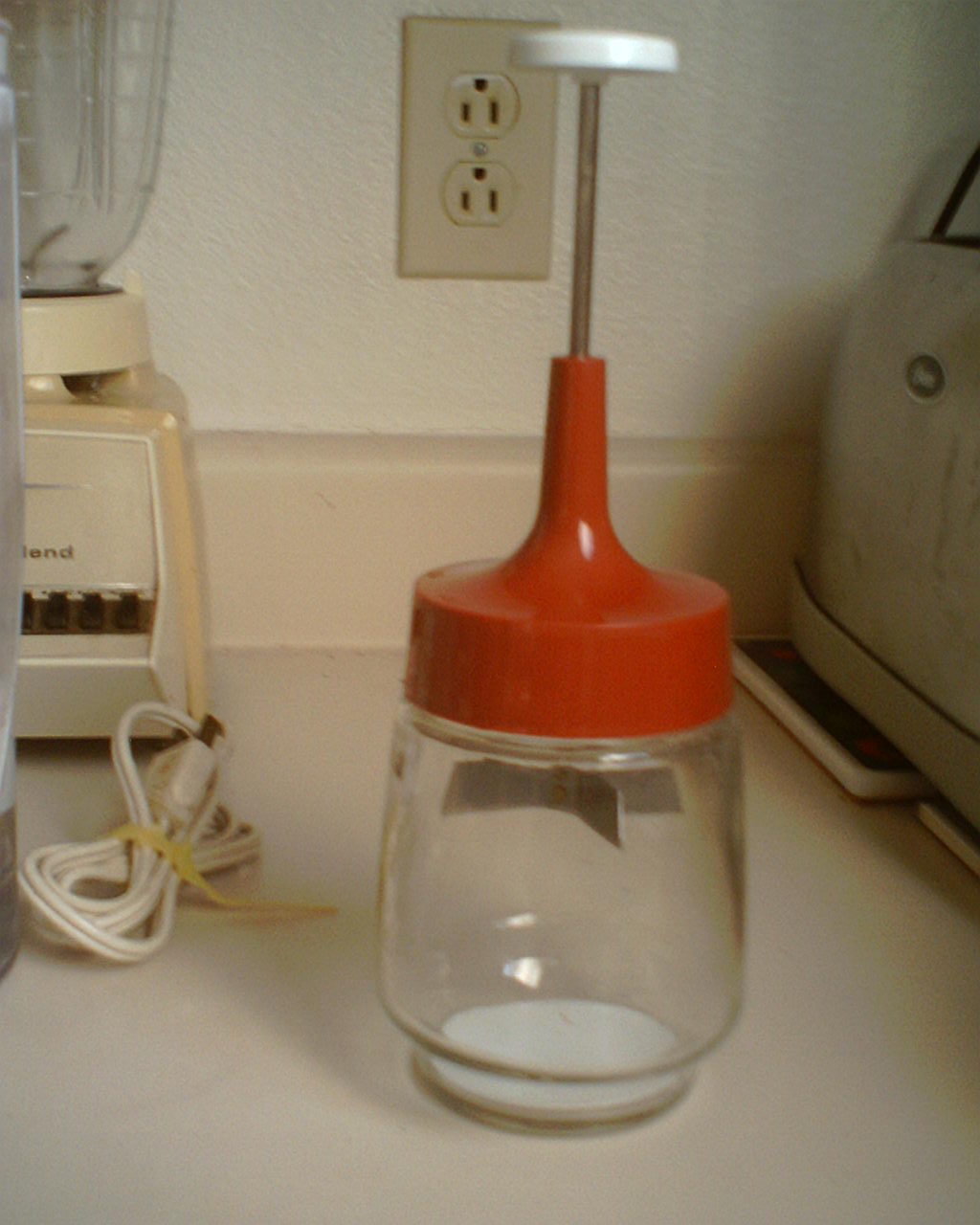
This chopper is advertised around the web as a vintage product, with a glass jar, made in the USA by Gemco. The price at Goodwill: $4, compared to about $15 elsewhere. And again, it works amazingly well!
Thursday, January 5, 2012
Reuse again... and again
I love second-hand shopping for numerous reasons, including the inexpensive prices, the ability to obtain higher quality goods that I could afford if they were new, and the fact that it's great for the environment.
For example, due to thrift shopping, my daughter received more gifts from her father and me than we could have privided her if we were buying new. We gave her a set of roller skates, a bigger bike, a boy Barbie, a dress, several cute tops and pants, and a Christmas teddy bear, all in excellent condition, for about $50 total.
Some object, however, that the second-hand market isn't practical for society at large since it always requires a first-hand market. That's true, but the complaint usually assumes a one-to-one relationship between the first-hand and second-hand market for each item. In other words, someone buys something new and donates or passes it on, then someone else gets it second-hand. Once the second person has finished with the item, that's the end of its life cycle.
Many items, however, can have multiple life cycles as long as they're still in good condition. Well-made, durable items like bikes and children's clothing (since kids tend to outgrow things quickly) can be passed on multiple times to multiple users before they're no longer in good condition.
Here's a good example: I purchased my daughter's old bike $8 from a thrift store two years ago. She has recently outgrown the bike and we found a larger one, in great condition, for $10 at Goodwill. It's very possible that either bike had multiple users (say, an older and younger sibling) before being donated and purchased by us.
One of my daughter's friends, two years older, also got a new bike for Christmas. Her mom and I planned at first to pass on both old bikes to younger children, but they were too big for the younger children we knew.
So I came up with an even better plan for passing on the two bikes. I had a meeting in Olympia today and had to pass through Lacey, where Alaffia, my favorite natural body care company, is based. Alaffia has a project, Bicycles for Education, in which they collect bikes from Washington residents to ship to Alaffia's founder's home country of Togo. These bikes make transportation to and from distant schools possible for many rural children who wouldn't otherwise be able to attend.
I dropped off both bikes at Alaffia's headquarters today and was able to have a follow-up conversation with them about hosting a bike drive at Marlene's Natural Market in Tacoma (which will take place in June). So you see, many items can be used not once, not twice, but again and again and again, for older children, younger children, and children across the world!
For example, due to thrift shopping, my daughter received more gifts from her father and me than we could have privided her if we were buying new. We gave her a set of roller skates, a bigger bike, a boy Barbie, a dress, several cute tops and pants, and a Christmas teddy bear, all in excellent condition, for about $50 total.
Some object, however, that the second-hand market isn't practical for society at large since it always requires a first-hand market. That's true, but the complaint usually assumes a one-to-one relationship between the first-hand and second-hand market for each item. In other words, someone buys something new and donates or passes it on, then someone else gets it second-hand. Once the second person has finished with the item, that's the end of its life cycle.
Many items, however, can have multiple life cycles as long as they're still in good condition. Well-made, durable items like bikes and children's clothing (since kids tend to outgrow things quickly) can be passed on multiple times to multiple users before they're no longer in good condition.
Here's a good example: I purchased my daughter's old bike $8 from a thrift store two years ago. She has recently outgrown the bike and we found a larger one, in great condition, for $10 at Goodwill. It's very possible that either bike had multiple users (say, an older and younger sibling) before being donated and purchased by us.
One of my daughter's friends, two years older, also got a new bike for Christmas. Her mom and I planned at first to pass on both old bikes to younger children, but they were too big for the younger children we knew.
So I came up with an even better plan for passing on the two bikes. I had a meeting in Olympia today and had to pass through Lacey, where Alaffia, my favorite natural body care company, is based. Alaffia has a project, Bicycles for Education, in which they collect bikes from Washington residents to ship to Alaffia's founder's home country of Togo. These bikes make transportation to and from distant schools possible for many rural children who wouldn't otherwise be able to attend.
I dropped off both bikes at Alaffia's headquarters today and was able to have a follow-up conversation with them about hosting a bike drive at Marlene's Natural Market in Tacoma (which will take place in June). So you see, many items can be used not once, not twice, but again and again and again, for older children, younger children, and children across the world!
Friday, December 9, 2011
When you're not the mom you want to be
I haven't done a lot of blogging in the last few months, mostly because I'm trying to figure out life.
I promised during the summer to write about what I was learning through a number of parenting and education books I had been reading. There were several thought-provoking ones among them, such as Po Bronson and Ashley Merryman's Nurture Shock and Ron Clark's The Excellent 11.
But the book that affected me the most was one I discovered by accident while reading a mystery novel (Lisa Gardner's Live to Tell). The novel tells the story of a group of children in a residential treatment center for kids with emotional and behavioral issues, whose families are being murdered. In the author's acknowledgements, she describes being drawn to write the story because of the experiences of a friend with such a child. She also cites Dr. Ross W. Greene's book, The Explosive Child and his "collaborative problem-solving approach," for shaping her thinking about kids with behavioral challenges and what can help them.
I found Dr. Greene's book in the library and decided to read it out of curiosity, not thinking it was really relevant to my life. My daughter's behavior isn't explosive (characterized by fits of rage, extreme tantrums and even violence). And yet, almost immediately upon starting it I knew that the book was extremely relevant to both my daughter and me.
The book establishes a key premise: that explosive children do not behave that way intentionally, because children do as well as they can. Instead, explosive children tend to lack certain skills that make less extreme emotional reactions possible. These include such things as the ability to tolerate frustration, disappointment and sudden changes; the ability to positively express and regulate one's emotions; perspective-taking and empathy; and others. When they encounter life's difficulties, they don't know how to handle it other than to explode.
The author describes his concept of collaborative problem-solving as a method in which invite your child to work through problems together, while you model and guide for your child ways to develop the personal and interpersonal skills they might be lacking.
As I read this, I knew exactly how it applied to my child and me. She doesn't explode when she's frustrated, disappointed, or struggling with her emotions; instead, she sulks and withdraws. It's not a more constructive method of handling problems, simply less destructive than exploding.
But I also realized this: I am not really equipped at this point to guide and model a different way for her, because I do the exact same thing. When I am frustrated, angry, overwhelmed or hurt, I sulk and I withdraw.
Reacting this way has had many negative effects on my family relationships, friendships, and career. I am trying to learn how to deal with it for my own sake and so that I can in turn help my daughter.
I met recently with our minister and talked through some of this. She pinpointed something about me: isolation has been a theme of my life. She's right. I have often heard that people's greatest fears are public speaking and death. I have never particularly feared either of those, but I have always feared being alone. Yet I have often felt alone, despite this fear. I am not shy, but I am reserved, and it is difficult for me to move past the acquaintance stage into true friendship with people--one of the reasons why our move to Washington State has been so difficult for me. (That is one area in which my daughter and I differ. She, like her father, is very outgoing).
It wasn't difficult for me to pinpoint the start of my isolation: something pretty awful happened to me when I was six (for a variety of reasons, I don't want to go into it online). But it seared into my psyche that I couldn't trust people to care about my needs or pain, and that it was dangerous to be vulnerable.
And that lesson took hold quickly. A year later, when I was 7, I was in a work group of four students in my class at school, and one of the other girls in the group began taunting me for reasons I don't remember. She was relentless to the point of leaving me in tears. But they were silent tears, so as not to attract the attention of our teacher. Another girl in the group went up to the teacher to ask for tissue for me. I assume the same girl later told the teacher what happened. The next morning, my teacher pulled me aside and asked, "Why didn't you tell me what was going on?"
I shrugged and didn't answer, but I was thinking, "Because you wouldn't have done anything about it." Already in second grade, I was that cynical.
I'm meeting with my minister again next week to discuss this further. But I know it's the root of my tendency to withdraw from others and myself when I'm facing problems, and my daughter is learning that from me. I want to be able to show her, and help her, discover a more positive way of dealing with difficulties.
I promised during the summer to write about what I was learning through a number of parenting and education books I had been reading. There were several thought-provoking ones among them, such as Po Bronson and Ashley Merryman's Nurture Shock and Ron Clark's The Excellent 11.
But the book that affected me the most was one I discovered by accident while reading a mystery novel (Lisa Gardner's Live to Tell). The novel tells the story of a group of children in a residential treatment center for kids with emotional and behavioral issues, whose families are being murdered. In the author's acknowledgements, she describes being drawn to write the story because of the experiences of a friend with such a child. She also cites Dr. Ross W. Greene's book, The Explosive Child and his "collaborative problem-solving approach," for shaping her thinking about kids with behavioral challenges and what can help them.
I found Dr. Greene's book in the library and decided to read it out of curiosity, not thinking it was really relevant to my life. My daughter's behavior isn't explosive (characterized by fits of rage, extreme tantrums and even violence). And yet, almost immediately upon starting it I knew that the book was extremely relevant to both my daughter and me.
The book establishes a key premise: that explosive children do not behave that way intentionally, because children do as well as they can. Instead, explosive children tend to lack certain skills that make less extreme emotional reactions possible. These include such things as the ability to tolerate frustration, disappointment and sudden changes; the ability to positively express and regulate one's emotions; perspective-taking and empathy; and others. When they encounter life's difficulties, they don't know how to handle it other than to explode.
The author describes his concept of collaborative problem-solving as a method in which invite your child to work through problems together, while you model and guide for your child ways to develop the personal and interpersonal skills they might be lacking.
As I read this, I knew exactly how it applied to my child and me. She doesn't explode when she's frustrated, disappointed, or struggling with her emotions; instead, she sulks and withdraws. It's not a more constructive method of handling problems, simply less destructive than exploding.
But I also realized this: I am not really equipped at this point to guide and model a different way for her, because I do the exact same thing. When I am frustrated, angry, overwhelmed or hurt, I sulk and I withdraw.
Reacting this way has had many negative effects on my family relationships, friendships, and career. I am trying to learn how to deal with it for my own sake and so that I can in turn help my daughter.
I met recently with our minister and talked through some of this. She pinpointed something about me: isolation has been a theme of my life. She's right. I have often heard that people's greatest fears are public speaking and death. I have never particularly feared either of those, but I have always feared being alone. Yet I have often felt alone, despite this fear. I am not shy, but I am reserved, and it is difficult for me to move past the acquaintance stage into true friendship with people--one of the reasons why our move to Washington State has been so difficult for me. (That is one area in which my daughter and I differ. She, like her father, is very outgoing).
It wasn't difficult for me to pinpoint the start of my isolation: something pretty awful happened to me when I was six (for a variety of reasons, I don't want to go into it online). But it seared into my psyche that I couldn't trust people to care about my needs or pain, and that it was dangerous to be vulnerable.
And that lesson took hold quickly. A year later, when I was 7, I was in a work group of four students in my class at school, and one of the other girls in the group began taunting me for reasons I don't remember. She was relentless to the point of leaving me in tears. But they were silent tears, so as not to attract the attention of our teacher. Another girl in the group went up to the teacher to ask for tissue for me. I assume the same girl later told the teacher what happened. The next morning, my teacher pulled me aside and asked, "Why didn't you tell me what was going on?"
I shrugged and didn't answer, but I was thinking, "Because you wouldn't have done anything about it." Already in second grade, I was that cynical.
I'm meeting with my minister again next week to discuss this further. But I know it's the root of my tendency to withdraw from others and myself when I'm facing problems, and my daughter is learning that from me. I want to be able to show her, and help her, discover a more positive way of dealing with difficulties.
Tuesday, November 15, 2011
Gabby Giffords' recovery on video--amazing!!
If you ever want to see inspiration--this is it!
Congresswoman Gabrielle Giffords, shot in the head last January. Her amazing recovery was chronicled on film by her husband, astronaut Mark Kelly.
Congresswoman Gabrielle Giffords, shot in the head last January. Her amazing recovery was chronicled on film by her husband, astronaut Mark Kelly.
Monday, October 24, 2011
Another homemade failure
Last week, I had my first-ever cavity filled.
I've always had good teeth, and in 40+ years had never had a cavity. In fact, other than having my widsom teeth pulled, I had never needed any dental care beyond routine checkups and cleanings. My husband is the same.
I know there's a lot of controversy about flouride, about its possible toxicity. I've even heard some say that flouride in our water supply and toothpastes is causing more dental problems than it solves.
I think there might be merit to the first charge (toxicity). I'm skeptical about the second. My parents had all kinds of dental problems, and I remember my mother observing that her children's better dental health was due to two things she lacked as a child: good dental care, and flouride toothpaste. I also remember reading an article in my early 20s that reported that half of American children have no cavities, a big improvement over previous generations that the article credited to flouride toothpaste and flouridated water.
In the past few years, I have tried several homemade personal care products. The products I've created for skin and hair care have worked beautifully. But two others were less successful. I gave up the first, homemade deodorant made of coconut oil, corn starch, baking soda and essential oils, because it made my underarms break out in an itchy rash.
I didn't have any immediate problems with the second, homemade toothpaste made of glycerin, baking soda, and peppermint oil. I stopped using it after a few months, however, because my teeth never felt as clean, nor my breath as fresh, as when I use conventional commercial toothpastes. I've tried a few natural toothpastes, and had the same, "they don't feel quite as clean" feeling.
In June, my family and I all had dental checkups. My daughter and my husband both had clean mouths, but I had my first cavity. I know I take better care of my teeth than either of them; my daughter is still trying to get the hang of flossing and my husband doesn't floss at all, but I floss daily. So why was I the only one to have the cavity? The only thing I can point to is the four months I went without using flouride toothpaste.
I've always had good teeth, and in 40+ years had never had a cavity. In fact, other than having my widsom teeth pulled, I had never needed any dental care beyond routine checkups and cleanings. My husband is the same.
I know there's a lot of controversy about flouride, about its possible toxicity. I've even heard some say that flouride in our water supply and toothpastes is causing more dental problems than it solves.
I think there might be merit to the first charge (toxicity). I'm skeptical about the second. My parents had all kinds of dental problems, and I remember my mother observing that her children's better dental health was due to two things she lacked as a child: good dental care, and flouride toothpaste. I also remember reading an article in my early 20s that reported that half of American children have no cavities, a big improvement over previous generations that the article credited to flouride toothpaste and flouridated water.
In the past few years, I have tried several homemade personal care products. The products I've created for skin and hair care have worked beautifully. But two others were less successful. I gave up the first, homemade deodorant made of coconut oil, corn starch, baking soda and essential oils, because it made my underarms break out in an itchy rash.
I didn't have any immediate problems with the second, homemade toothpaste made of glycerin, baking soda, and peppermint oil. I stopped using it after a few months, however, because my teeth never felt as clean, nor my breath as fresh, as when I use conventional commercial toothpastes. I've tried a few natural toothpastes, and had the same, "they don't feel quite as clean" feeling.
In June, my family and I all had dental checkups. My daughter and my husband both had clean mouths, but I had my first cavity. I know I take better care of my teeth than either of them; my daughter is still trying to get the hang of flossing and my husband doesn't floss at all, but I floss daily. So why was I the only one to have the cavity? The only thing I can point to is the four months I went without using flouride toothpaste.
Friday, September 30, 2011
How'd my summer go?
OK, I know, it's been a while since I've posted. And after my high school friend, Laura, sent me a birthday card telling me my blog was how she keeps up with my life! (Hi, Laura!)
My excuses... work has been busy, I've been getting used to apartment living, blah blah blah. (Meaning: no good excuse).
So, time to fill you in on my summer:
Still savoring? Not as much: OK, I've fallen off the wagon a few times from my "savor the sweets" diet, and have times when I indulge my sweet tooth more than I should. But still, at a doctor's appointment this week I weighed 153 lbs, down from 160 at my physical in April, so I'm making progress.
Green apartment living
We moved in May from a house to an apartment, and not long after our move, I shared about some of the "green" advantages I anticipated to apartment living. After 3 months, here is my report:
Growing our own food--a challenge: Because we moved too late in the season to start planting seeds, I bought starts. Our apartment is one of a series of buildings that surrounds a courtyard filled with large trees. Our small balcony overlooks the courtyard, and thus gets virtually no direct sunlight.
The starts I bought were for plants that can do well with little sunlight--cilantro, basil, mint, and lettuce. The basil and mint made it through the summer (but weakly), and the cilantro and lettuce didn't make it at all. I have a lot to learn about growing food in our current circumstances, so I'll try again next summer.
Composting--bokashi on the cheap: I had long heard about bokashi apartment composting. A bokashi system is an anaerobic composter--basically a bucket with a drip spout that allows you to drain off the "tea" (the liquid residue of your compost, which can be diluted and used as a fertilizer). Bokashi is a mixture of bran, molasses and microorganisms that, when added to your food scraps, accelerates their decomposition through a fermentation process. It's ideal for apartment-dwellers, because it's compact, it's an anaerobic system so fruit flies and other pests can't get into it, and because of the fermentation process, it doesn't smell. (Well, yes it does. But it smells like something fermented, rather than like rotten garbage).
A bokashi system can be expensive (about $120). But a gallon of the bokashi mixture is pretty cheap (about $15) and it lasts several months. As some experienced composters have pointed out, a bokashi system is just a bucket with a secure-fitting lid. Thus, you can do bokashi as long as you have such a bucket. I use a large container that once held ice cream served at a church social. You can also ask fast food places if you can have their left-over pickle buckets. If you're really ambitious, you can drill a hole in the bucket and add a drip spout to catch the "tea." But if you are like me, you can just add your food scraps to a Bio-bag in the bucket, and the bokashi "tea" will seep through the bag and pool in the bottom.
The challenge of using bokashi is that once the food scraps are well-fermented, you need to bury them. Once buried, the scraps decompose rapidly and supposedly make incredibly rich compost. I bought a large garbage can for my balcony, filled it with potting soil, and I'm adding the bokashi'd scraps periodically. I'm not sure how well this will work. My plan is to take a sample of the soil to the WA State Master Gardeners in the spring and have them test it to see how healthy it is. Stay tuned.
Transportation--still working on it: I haven't walked or used public transportation as often as I'd planned. Mostly, it's a function of time, since it's faster to drive. In addition, because my daughter's daycare teacher asked to participate in our summer staycation adventures, I often needed to drive because I was transporting other children besides my daughter. However, we have walked or taken the bus on several occasions, so I am patting myself on the back as an encouragement to keep it up and do more.
I haven't learned as much about my car as I had planned. I have been tracking my mileage, and I have made a few changes to improve gas mileage. I removed the luggage racks from my vehicle to reduce the weight, I am keeping my tires inflated, and I learned that the click my gas cap makes when I turned it--which I always thought was a warning not to turn it anymore--is actually a good thing. I should keep turning the gas cap until I hear it click three times, and then I know that it is fully closed and unlikely to evaporate gas.
But my biggest challenge is staying within the speed limit of 60-65 on the highway. The average speed of those around me is 70, and I'm often following the crowd (usually to make sure I get to work on time). I have found that my gas mileage can go from a low of 20 miles per gallon to a high of 35 mpg, all depending on my speed. This, and walking or taking public transportation more often, are often functions of my own discipline. If I plan my time better, I can improve in both areas.
Small green steps: I wrote about my switch to a Moon Cup back in June. I still love it, and the switch came just in time. In June, I also had an IUD inserted, which increases menstrual flow.
Otherwise, I've made two changes this summer:
Reusable straws: I purchased stainless steel drinking straws, which my daughter and I both love! They're easy to clean with the straw brush that comes with them, and neither of us have experienced the complaints some have of funny taste or getting too cold. (Those concerns, if you have them, can be alleviated with glass drinking straws. I didn't want to go that route because I was concerned that my daughter might break them, even though they're made from very strong glass).
Homemade air freshener spray: I have used natural air freshener sprays for some time, but I read recently that those may still contain phthalates. So when my last bottle of Air Therapy ran out, I decided to try making my own. Here are two recipes I use. They're more mild than commercial air fresheners, but they smell good and do the job:
Peppermint/orange air freshener: add 1/2 cup of filtered water, 1/2 cup of vodka, and 20 drops each of peppermint oil and sweet orange oil to a spray bottle. Shake before each use.
Cinnamon/vanilla air freshener: Add 1 cup filtered water, 1 cup white vinegar, 2 cinnamon sticks and 1 tablespoon of vanilla extract to a pot. Bring to boil, and then reduce to low, cover and simmer 10 minutes. Allow to cool, and then add to a spray bottle. Shake before each use.
~~~~~~~~~~~~~~~~~~~~
The biggest focus of my summer has been my daughter. In another post, I'll share about our summer adventures, and my summer reading about parenting and teaching.
My excuses... work has been busy, I've been getting used to apartment living, blah blah blah. (Meaning: no good excuse).
So, time to fill you in on my summer:
Still savoring? Not as much: OK, I've fallen off the wagon a few times from my "savor the sweets" diet, and have times when I indulge my sweet tooth more than I should. But still, at a doctor's appointment this week I weighed 153 lbs, down from 160 at my physical in April, so I'm making progress.
Green apartment living
We moved in May from a house to an apartment, and not long after our move, I shared about some of the "green" advantages I anticipated to apartment living. After 3 months, here is my report:
Growing our own food--a challenge: Because we moved too late in the season to start planting seeds, I bought starts. Our apartment is one of a series of buildings that surrounds a courtyard filled with large trees. Our small balcony overlooks the courtyard, and thus gets virtually no direct sunlight.
The starts I bought were for plants that can do well with little sunlight--cilantro, basil, mint, and lettuce. The basil and mint made it through the summer (but weakly), and the cilantro and lettuce didn't make it at all. I have a lot to learn about growing food in our current circumstances, so I'll try again next summer.
Composting--bokashi on the cheap: I had long heard about bokashi apartment composting. A bokashi system is an anaerobic composter--basically a bucket with a drip spout that allows you to drain off the "tea" (the liquid residue of your compost, which can be diluted and used as a fertilizer). Bokashi is a mixture of bran, molasses and microorganisms that, when added to your food scraps, accelerates their decomposition through a fermentation process. It's ideal for apartment-dwellers, because it's compact, it's an anaerobic system so fruit flies and other pests can't get into it, and because of the fermentation process, it doesn't smell. (Well, yes it does. But it smells like something fermented, rather than like rotten garbage).
A bokashi system can be expensive (about $120). But a gallon of the bokashi mixture is pretty cheap (about $15) and it lasts several months. As some experienced composters have pointed out, a bokashi system is just a bucket with a secure-fitting lid. Thus, you can do bokashi as long as you have such a bucket. I use a large container that once held ice cream served at a church social. You can also ask fast food places if you can have their left-over pickle buckets. If you're really ambitious, you can drill a hole in the bucket and add a drip spout to catch the "tea." But if you are like me, you can just add your food scraps to a Bio-bag in the bucket, and the bokashi "tea" will seep through the bag and pool in the bottom.
The challenge of using bokashi is that once the food scraps are well-fermented, you need to bury them. Once buried, the scraps decompose rapidly and supposedly make incredibly rich compost. I bought a large garbage can for my balcony, filled it with potting soil, and I'm adding the bokashi'd scraps periodically. I'm not sure how well this will work. My plan is to take a sample of the soil to the WA State Master Gardeners in the spring and have them test it to see how healthy it is. Stay tuned.
Transportation--still working on it: I haven't walked or used public transportation as often as I'd planned. Mostly, it's a function of time, since it's faster to drive. In addition, because my daughter's daycare teacher asked to participate in our summer staycation adventures, I often needed to drive because I was transporting other children besides my daughter. However, we have walked or taken the bus on several occasions, so I am patting myself on the back as an encouragement to keep it up and do more.
I haven't learned as much about my car as I had planned. I have been tracking my mileage, and I have made a few changes to improve gas mileage. I removed the luggage racks from my vehicle to reduce the weight, I am keeping my tires inflated, and I learned that the click my gas cap makes when I turned it--which I always thought was a warning not to turn it anymore--is actually a good thing. I should keep turning the gas cap until I hear it click three times, and then I know that it is fully closed and unlikely to evaporate gas.
But my biggest challenge is staying within the speed limit of 60-65 on the highway. The average speed of those around me is 70, and I'm often following the crowd (usually to make sure I get to work on time). I have found that my gas mileage can go from a low of 20 miles per gallon to a high of 35 mpg, all depending on my speed. This, and walking or taking public transportation more often, are often functions of my own discipline. If I plan my time better, I can improve in both areas.
Small green steps: I wrote about my switch to a Moon Cup back in June. I still love it, and the switch came just in time. In June, I also had an IUD inserted, which increases menstrual flow.
Otherwise, I've made two changes this summer:
Reusable straws: I purchased stainless steel drinking straws, which my daughter and I both love! They're easy to clean with the straw brush that comes with them, and neither of us have experienced the complaints some have of funny taste or getting too cold. (Those concerns, if you have them, can be alleviated with glass drinking straws. I didn't want to go that route because I was concerned that my daughter might break them, even though they're made from very strong glass).
Homemade air freshener spray: I have used natural air freshener sprays for some time, but I read recently that those may still contain phthalates. So when my last bottle of Air Therapy ran out, I decided to try making my own. Here are two recipes I use. They're more mild than commercial air fresheners, but they smell good and do the job:
Peppermint/orange air freshener: add 1/2 cup of filtered water, 1/2 cup of vodka, and 20 drops each of peppermint oil and sweet orange oil to a spray bottle. Shake before each use.
Cinnamon/vanilla air freshener: Add 1 cup filtered water, 1 cup white vinegar, 2 cinnamon sticks and 1 tablespoon of vanilla extract to a pot. Bring to boil, and then reduce to low, cover and simmer 10 minutes. Allow to cool, and then add to a spray bottle. Shake before each use.
~~~~~~~~~~~~~~~~~~~~
The biggest focus of my summer has been my daughter. In another post, I'll share about our summer adventures, and my summer reading about parenting and teaching.
Thursday, August 18, 2011
Learning to savor
Until I hit my 30's, I was one of those super-skinny people who could eat anything she wanted and never gain an ounce. At 5'7", I weighed about 115 lbs. on average. My low weight came with its drawbacks: I almost always felt too cold, except on the warmest of days; despite what the media tell us, most men aren't attracted to women with "boyish" figures; and I got sick frequently, with sickness taking a horrible toll on my body since I had no stores of fat or extra nutrients to protect me.
I knew even then that my thinness wouldn't last. Throughout my childhood, I witnessed my mom and aunts, almost all of whom had been very thin as young women, struggle with dieting and weight. I knew that one day, too, I would start to gain. I didn't want to end up in that same cycle, so in my 20's, I decided that I needed to eat better.
At that age, eating better meant giving up red meat and fried foods (unless I was being served such foods as someone's guest). Nevertheless, I still started gaining weight when I hit my 30's, and the first 20 to 30 additional pounds were very welcome. I finally had a womanly figure, I wasn't constantly freezing, and I definitely became less sickly.
Over time, I have continued to improve my eating habits. Since I started my green journey when my now 6-year-old was a baby, I eat more vegetarian and vegan meals, more whole and organic foods, and more fruits and vegetables.
But of course, I had given birth, with all its changes to a woman's body. And then I turned 40, with all its changes to a woman's metabolism. So I was still gaining weight.
At my last physical in April I weighed 160 lbs, which is right over the edge into "overweight" BMI. I've never officially dieted, but I know that I now have to do something to manage my weight.
I decided that I need to do two things: 1) manage the amounts of food I am eating. What I am eating (for the most part) is not a problem, it's how much; and 2) manage my sweet tooth.
With the former, I am using the "smaller plate" method of managing portion sizes, and writing down everything I eat. Writing it all down is a great tool, because it makes me very aware of what I'm putting into my mouth. No more mindless grazing, or going back for seconds without thinking about it.
The sweet tooth is the bigger challenge. I love sweets, especially chocolate. I have often had days in which I eat, say, oatmeal and OJ for breakfast, a salad for lunch, and salmon, broccoli and brown rice for dinner. And that same day, throughout the day, I would polish off an entire bag of chocolate chip cookies. Most of my weight gain is probably the result of my sweet tooth.
I couldn't imagine giving up sweets or chocolate altogether, so this is how I've decided to deal with it: I am learning to savor. For example, Safeway sells bags of "Dark Chocolate Covered Mint Cups," a transfat-free candy about the size of a mini Reese's cup. A serving is 3 pieces, but after lunch I am eating one. One piece contains about 63 calories, 3 grams of fat and 2 grams of saturated fat. I take a tiny bite and let it sit on my tongue until it melts, moving it around so I can fully taste it. Then I wait a while and do it again. I can make one piece last an hour, and I'm working on extending that time.
After dinner, I am doing the same with, for example, about 2 ounces of homemade tofu chocolate mousse (made from silken tofu, melted semi-sweet chocolate chips, a little mint or almond extract, and enough almond or rice milk to make it smooth, blended in a blender and chilled). I take a small spoonful and savor it.
In this way I'm getting the same joyful thrill I always get from eating chocolate, without all the calories I used to consume because I couldn't stop eating more and more.
I'm seeing a secondary benefit: perhaps because I am consuming less sugar, fruit is becoming more satisfying to my sweet tooth. I've always like fruit, but given a choice between fruit or cookies, I would almost always go for cookies. But now I'm starting to choose fruit, knowing it can give me a thrill, too.
So far, my "diet" plan is working. I'm down to 155, and my goal is 145.
I knew even then that my thinness wouldn't last. Throughout my childhood, I witnessed my mom and aunts, almost all of whom had been very thin as young women, struggle with dieting and weight. I knew that one day, too, I would start to gain. I didn't want to end up in that same cycle, so in my 20's, I decided that I needed to eat better.
At that age, eating better meant giving up red meat and fried foods (unless I was being served such foods as someone's guest). Nevertheless, I still started gaining weight when I hit my 30's, and the first 20 to 30 additional pounds were very welcome. I finally had a womanly figure, I wasn't constantly freezing, and I definitely became less sickly.
Over time, I have continued to improve my eating habits. Since I started my green journey when my now 6-year-old was a baby, I eat more vegetarian and vegan meals, more whole and organic foods, and more fruits and vegetables.
But of course, I had given birth, with all its changes to a woman's body. And then I turned 40, with all its changes to a woman's metabolism. So I was still gaining weight.
At my last physical in April I weighed 160 lbs, which is right over the edge into "overweight" BMI. I've never officially dieted, but I know that I now have to do something to manage my weight.
I decided that I need to do two things: 1) manage the amounts of food I am eating. What I am eating (for the most part) is not a problem, it's how much; and 2) manage my sweet tooth.
With the former, I am using the "smaller plate" method of managing portion sizes, and writing down everything I eat. Writing it all down is a great tool, because it makes me very aware of what I'm putting into my mouth. No more mindless grazing, or going back for seconds without thinking about it.
The sweet tooth is the bigger challenge. I love sweets, especially chocolate. I have often had days in which I eat, say, oatmeal and OJ for breakfast, a salad for lunch, and salmon, broccoli and brown rice for dinner. And that same day, throughout the day, I would polish off an entire bag of chocolate chip cookies. Most of my weight gain is probably the result of my sweet tooth.
I couldn't imagine giving up sweets or chocolate altogether, so this is how I've decided to deal with it: I am learning to savor. For example, Safeway sells bags of "Dark Chocolate Covered Mint Cups," a transfat-free candy about the size of a mini Reese's cup. A serving is 3 pieces, but after lunch I am eating one. One piece contains about 63 calories, 3 grams of fat and 2 grams of saturated fat. I take a tiny bite and let it sit on my tongue until it melts, moving it around so I can fully taste it. Then I wait a while and do it again. I can make one piece last an hour, and I'm working on extending that time.
After dinner, I am doing the same with, for example, about 2 ounces of homemade tofu chocolate mousse (made from silken tofu, melted semi-sweet chocolate chips, a little mint or almond extract, and enough almond or rice milk to make it smooth, blended in a blender and chilled). I take a small spoonful and savor it.
In this way I'm getting the same joyful thrill I always get from eating chocolate, without all the calories I used to consume because I couldn't stop eating more and more.
I'm seeing a secondary benefit: perhaps because I am consuming less sugar, fruit is becoming more satisfying to my sweet tooth. I've always like fruit, but given a choice between fruit or cookies, I would almost always go for cookies. But now I'm starting to choose fruit, knowing it can give me a thrill, too.
So far, my "diet" plan is working. I'm down to 155, and my goal is 145.
Tuesday, August 16, 2011
Parenting advice that works!
I love reading parenting books. I feel like I need a lot of help, and many books out there have great advice. (In a later post, I'll share some of what I've been learning this summer).
But of course, there are so many parenting books out there, and some give differing or contradictory advice. How do you decide which advice to follow?
I have a good friend whose daughter was born a year after my daughter, and I wrote her a letter upon her daughter's birth titled something like, "The Ten Lessons I Learned from My First Year as a Parent." I don't remember all 10, but I do remember that I wrote something like the following about parenting advice: "Take it all in, weigh it, and decide whether it makes sense to you based on your experiences and what you know about your child. And if you're not sure, try it out and evaluate the results." In other words, parenting advice is just that--advice, not truth etched in stone. Advice can be weighed, examined, tried, evaluated, and even rejected.*
One piece of advice I have often read is about children who are picky eaters. The general consensus is that you shouldn't force children to eat anything, just encourage them to try new foods, and eventually they'll eat a variety. Other tips are offered: for example, having children help you grow, cook or prepare foods, and setting a good example by eating healthy foods yourself are recommended.
Still, there are some dissenters from this advice, those who say that kids learn to eat all kinds of foods only when not given a choice about whether or what to eat or not. And sometimes I struggled with whether or not that was true. Here is my tale...
My stubborn mama: My mom grew up with Depression-era parents who were of the mindset that you never waste food and you eat what's put before you or else. My mom, however, was both a very picky eater and very stubborn, and she fought them tooth and nail in this arena. If she was told she couldn't get up until she cleaned her plate, she sat at the table all day. If she was told that she could leave the table but would have to eat the same plate at the next mealtime, she'd go hungry. When faced with a kid that stubborn, parents either have to give in or become abusive (force-feed the kid, beat them, or starve them). Since my grandparents weren't abusive, eventually they'd give in.
But my mother never forgot those battles, and never really overcame her aversion to many foods, either. To this day, she hates oatmeal and most vegetables, except for sweet potatoes, green beans and iceberg lettuce.** And she decided that she wasn't going to battle with her own kids at the table.
She'd serve vegetables, even though she didn't like them, because she knew they were good for kids. But she'd make deals with us: we had to eat as many bites as we were old. Or, if a nutritional equivalent was in the fridge (a salad, or a leftover vegetable we liked), we could exchange it for what was on our plate. Because of this system, there weren't any dinner table battles in our home. But there might not have been anyway, since my siblings and I weren't very picky eaters. (I only disliked peas and lima beans).
My picky daughter: I had hoped for the same with my daughter, but alas, it wasn't to be. While she happily accepted baby food veggies at first, at about 18 months she started spitting them out. By age 3, the only vegetable she would eat was French fries with ketchup. And that bit of advice about how after 15-20 tries of a new food a kid will eat something? Not my kid. I tried hard not to compare her to my niece, who at age 3 was happily ordering bowls of broccoli for lunch.
At this point, I began to doubt the "don't force them, give it time" advice. Only the realization of how forcing a kid to eat backfired with my mom held me in check.
You know what? It eventually paid off. It took a lot more than 15-20 tries, but by age 4, she was gradually accepting vegetables again. First carrots, then celery, then salads, and so on.
Success! On Sunday afternoon, my 6-year-old daughter asked to make her own lunch, and I said yes. Usually when she makes something for herself, it's a sandwich or a bowl of cereal. This Sunday, however, was different: she made a salad. And not just a basic lettuce salad, either. Her salad (in a big bowl, btw!) contained romaine lettuce, broccoli, cucumbers, celery, green beans and carrots. She added ranch dressing and ate the whole thing! Patience and a good example paid off.
~~~~~~~~~~~~~
* One piece of advice I rejected when my daughter was an infant: read to your baby 20 minutes a day. Whose infant can sit through a 20-minute story??! Not mine. She'd either fall asleep after a minute or two, or grab the book and chew it! By age 2, however, she loved to have stories read to her.
** My mom, of course, waited until we were adults to tell us this.
But of course, there are so many parenting books out there, and some give differing or contradictory advice. How do you decide which advice to follow?
I have a good friend whose daughter was born a year after my daughter, and I wrote her a letter upon her daughter's birth titled something like, "The Ten Lessons I Learned from My First Year as a Parent." I don't remember all 10, but I do remember that I wrote something like the following about parenting advice: "Take it all in, weigh it, and decide whether it makes sense to you based on your experiences and what you know about your child. And if you're not sure, try it out and evaluate the results." In other words, parenting advice is just that--advice, not truth etched in stone. Advice can be weighed, examined, tried, evaluated, and even rejected.*
One piece of advice I have often read is about children who are picky eaters. The general consensus is that you shouldn't force children to eat anything, just encourage them to try new foods, and eventually they'll eat a variety. Other tips are offered: for example, having children help you grow, cook or prepare foods, and setting a good example by eating healthy foods yourself are recommended.
Still, there are some dissenters from this advice, those who say that kids learn to eat all kinds of foods only when not given a choice about whether or what to eat or not. And sometimes I struggled with whether or not that was true. Here is my tale...
My stubborn mama: My mom grew up with Depression-era parents who were of the mindset that you never waste food and you eat what's put before you or else. My mom, however, was both a very picky eater and very stubborn, and she fought them tooth and nail in this arena. If she was told she couldn't get up until she cleaned her plate, she sat at the table all day. If she was told that she could leave the table but would have to eat the same plate at the next mealtime, she'd go hungry. When faced with a kid that stubborn, parents either have to give in or become abusive (force-feed the kid, beat them, or starve them). Since my grandparents weren't abusive, eventually they'd give in.
But my mother never forgot those battles, and never really overcame her aversion to many foods, either. To this day, she hates oatmeal and most vegetables, except for sweet potatoes, green beans and iceberg lettuce.** And she decided that she wasn't going to battle with her own kids at the table.
She'd serve vegetables, even though she didn't like them, because she knew they were good for kids. But she'd make deals with us: we had to eat as many bites as we were old. Or, if a nutritional equivalent was in the fridge (a salad, or a leftover vegetable we liked), we could exchange it for what was on our plate. Because of this system, there weren't any dinner table battles in our home. But there might not have been anyway, since my siblings and I weren't very picky eaters. (I only disliked peas and lima beans).
My picky daughter: I had hoped for the same with my daughter, but alas, it wasn't to be. While she happily accepted baby food veggies at first, at about 18 months she started spitting them out. By age 3, the only vegetable she would eat was French fries with ketchup. And that bit of advice about how after 15-20 tries of a new food a kid will eat something? Not my kid. I tried hard not to compare her to my niece, who at age 3 was happily ordering bowls of broccoli for lunch.
At this point, I began to doubt the "don't force them, give it time" advice. Only the realization of how forcing a kid to eat backfired with my mom held me in check.
You know what? It eventually paid off. It took a lot more than 15-20 tries, but by age 4, she was gradually accepting vegetables again. First carrots, then celery, then salads, and so on.
Success! On Sunday afternoon, my 6-year-old daughter asked to make her own lunch, and I said yes. Usually when she makes something for herself, it's a sandwich or a bowl of cereal. This Sunday, however, was different: she made a salad. And not just a basic lettuce salad, either. Her salad (in a big bowl, btw!) contained romaine lettuce, broccoli, cucumbers, celery, green beans and carrots. She added ranch dressing and ate the whole thing! Patience and a good example paid off.
~~~~~~~~~~~~~
* One piece of advice I rejected when my daughter was an infant: read to your baby 20 minutes a day. Whose infant can sit through a 20-minute story??! Not mine. She'd either fall asleep after a minute or two, or grab the book and chew it! By age 2, however, she loved to have stories read to her.
** My mom, of course, waited until we were adults to tell us this.
Saturday, August 6, 2011
A bunch of cheap (and sometimes green) tips
Thrift store finds, repurposed for fruits and veggies:
~ Crocheted cloth squares, probably created as trivets or potholders, for scrubbing veggies, in place of plastic veggies scrubbers. I had tried a natural coconut coir veggie brush, but disliked it because it shed bristles and often bruised or damaged my produce. These squares are soft enough to prevent damage to produce, but have enough texture to scrub fruit and veggies well.
~ Cloth diapers for patting fruits and veggies dry after washing. They’re very absorbent, and it saves paper towels.
Cough medicine: In the moldy Northwest, I have been plagued by long-term coughs. This recipe is a great cough reliever: mix 1/2 tablespoon of apple cider vinegar and 1/2 tablespoon of honey in 8 ounces of warm water, and drink.
Car dehydrator: I found this wonderful tip at The TangledNest.com blog. I had long wanted to try Condo Blue’s recipe for making orange essential oil, but couldn’t prevent my orange peels from molding while I was drying them out. Now I just place the peels in my car dashboard window on sunny days, and by the end of the day, I have hard, dry orange peels. And the car smells great while they’re drying! (Of course, in Washington State, I can only do this in the summer).
Reduce fat and sugar with water: Sometimes the most natural products in the store (not counting meat or produce), with the least additives, contain the most fat and sugar. Natural mayonnaise, for example, or real maple syrup. I have found that adding water to these is a good way to reduce the fat or sugar content, without the additives of the "lite" version. (I even read a suggestion on another blog recently: buy a half gallon of whole milk, pour it into a gallon jug, and add water. Presto, a gallon of reduced fat milk at reduced cost! It's one way to better afford organic milk).
Btw, you’ll often notice that in “lite” versions of products, water is the first or second ingredient anyway. All the additives are added in order to give it the same thickness or taste as the original product, or to prevent separation. So if you’re going to add water, it’s important to only do so with the quantity you’re going to use, right before you use it. It will be thinner, but if you eat it right away, it generally doesn’t separate or affect taste. Experiment to find out the ratio you like best: 4:1 (where 1 is water), 3:1, 2:1 or 1:1. Whichever you choose, you'll be stretching your budget by making the food item last longer, and you'll be reducing fat and/or sugar.
Homemade chocolate sauce: Add 1/2 cup of semi-sweet chocolate chips, 1/4 cup milk of your choice (regular, soy, almond, rice, etc.), and 1 tablespoon of a mild oil (I use canola) to a small glass bowl. Stir gently to coat the chips. Microwave on high for one minute. Remove from microwave and (optional) add 1/2 teaspoon of flavoring (I usually add peppermint extract). Stir until smooth. Serve immediately over fruit, ice cream, cake or other dessert of your choice. Yum!
~ Crocheted cloth squares, probably created as trivets or potholders, for scrubbing veggies, in place of plastic veggies scrubbers. I had tried a natural coconut coir veggie brush, but disliked it because it shed bristles and often bruised or damaged my produce. These squares are soft enough to prevent damage to produce, but have enough texture to scrub fruit and veggies well.
~ Cloth diapers for patting fruits and veggies dry after washing. They’re very absorbent, and it saves paper towels.
Cough medicine: In the moldy Northwest, I have been plagued by long-term coughs. This recipe is a great cough reliever: mix 1/2 tablespoon of apple cider vinegar and 1/2 tablespoon of honey in 8 ounces of warm water, and drink.
Car dehydrator: I found this wonderful tip at The TangledNest.com blog. I had long wanted to try Condo Blue’s recipe for making orange essential oil, but couldn’t prevent my orange peels from molding while I was drying them out. Now I just place the peels in my car dashboard window on sunny days, and by the end of the day, I have hard, dry orange peels. And the car smells great while they’re drying! (Of course, in Washington State, I can only do this in the summer).
Reduce fat and sugar with water: Sometimes the most natural products in the store (not counting meat or produce), with the least additives, contain the most fat and sugar. Natural mayonnaise, for example, or real maple syrup. I have found that adding water to these is a good way to reduce the fat or sugar content, without the additives of the "lite" version. (I even read a suggestion on another blog recently: buy a half gallon of whole milk, pour it into a gallon jug, and add water. Presto, a gallon of reduced fat milk at reduced cost! It's one way to better afford organic milk).
Btw, you’ll often notice that in “lite” versions of products, water is the first or second ingredient anyway. All the additives are added in order to give it the same thickness or taste as the original product, or to prevent separation. So if you’re going to add water, it’s important to only do so with the quantity you’re going to use, right before you use it. It will be thinner, but if you eat it right away, it generally doesn’t separate or affect taste. Experiment to find out the ratio you like best: 4:1 (where 1 is water), 3:1, 2:1 or 1:1. Whichever you choose, you'll be stretching your budget by making the food item last longer, and you'll be reducing fat and/or sugar.
Homemade chocolate sauce: Add 1/2 cup of semi-sweet chocolate chips, 1/4 cup milk of your choice (regular, soy, almond, rice, etc.), and 1 tablespoon of a mild oil (I use canola) to a small glass bowl. Stir gently to coat the chips. Microwave on high for one minute. Remove from microwave and (optional) add 1/2 teaspoon of flavoring (I usually add peppermint extract). Stir until smooth. Serve immediately over fruit, ice cream, cake or other dessert of your choice. Yum!
Thursday, July 21, 2011
I will not complain
I used to hate winters in Boston, because I couldn't handle the cold. In my twenties, I was very, very thin. (You know those people who can eat anything and never gain an ounce? That was me back then. Alas, now that I'm over 40 and post childbirth, that's no longer true). Because I had so little body fat, cold temperatures took a toll on my body.
A store's motto, however, changed my perspective. I had a boyfriend who planned a hiking trip with some other guys in New Hampshire's White Mountains in November. He visited a ski shop to buy outerwear for the hike, and told me that the store had a motto proudly displayed on its walls: "There's no such thing as bad weather, only bad clothing." Hearing that made me consider that maybe the problem was that I wasn't dressing warmly enough for the cold. I began to wear more layers and found it made a difference. For the first time, I could appreciate, or at least not loathe, Boston's winters. (Of course, gaining weight once I hit my 30s helped, too).
I also made a decision to be grateful for the weather, whatever it happened to be. That attitude served me well during my years in Boston, but I had forgotten it here in Washington. I found myself once more loathing a season, but in this case, it was Western Washington's nine-month rainy season from September through May.
But now... most of our relatives and old friends are living in parts of the U.S. that are sweltering. And meanwhile, I've heard a few locals here in Washington complain about the cool summer. I can't join them.
I will not complain. I know what I could be experiencing, and by that measure, this summer in Tacoma has been beautiful. Yes, it's cooler than usual, but the sun peeks out for several hours most days (sometimes even the entire day!), and by afternoon it often hits a balmy 70 degrees. I drive from work with the sun on my face and have a good hour or so to watch my daughter ride her bike outdoors after I get home. I can drive with the windows rolled up so I can hear the radio or a CD, without needing to turn on the car's AC. We not only don't need AC in our home, we've only needed to use a fan a couple times this summer -- saving both energy and money.
Yes, I most certainly can't complain. Instead, I am grateful for the summer we're having, and I pray for all those suffering across our nation.
~~~~~~~~~~~~~~~
FYI: Crunchy Chicken offers a great list of tips for keeping cool this summer.
For more on what's happening this summer across the U.S., this Weather Channel post shares some sobering information.
A store's motto, however, changed my perspective. I had a boyfriend who planned a hiking trip with some other guys in New Hampshire's White Mountains in November. He visited a ski shop to buy outerwear for the hike, and told me that the store had a motto proudly displayed on its walls: "There's no such thing as bad weather, only bad clothing." Hearing that made me consider that maybe the problem was that I wasn't dressing warmly enough for the cold. I began to wear more layers and found it made a difference. For the first time, I could appreciate, or at least not loathe, Boston's winters. (Of course, gaining weight once I hit my 30s helped, too).
I also made a decision to be grateful for the weather, whatever it happened to be. That attitude served me well during my years in Boston, but I had forgotten it here in Washington. I found myself once more loathing a season, but in this case, it was Western Washington's nine-month rainy season from September through May.
But now... most of our relatives and old friends are living in parts of the U.S. that are sweltering. And meanwhile, I've heard a few locals here in Washington complain about the cool summer. I can't join them.
I will not complain. I know what I could be experiencing, and by that measure, this summer in Tacoma has been beautiful. Yes, it's cooler than usual, but the sun peeks out for several hours most days (sometimes even the entire day!), and by afternoon it often hits a balmy 70 degrees. I drive from work with the sun on my face and have a good hour or so to watch my daughter ride her bike outdoors after I get home. I can drive with the windows rolled up so I can hear the radio or a CD, without needing to turn on the car's AC. We not only don't need AC in our home, we've only needed to use a fan a couple times this summer -- saving both energy and money.
Yes, I most certainly can't complain. Instead, I am grateful for the summer we're having, and I pray for all those suffering across our nation.
~~~~~~~~~~~~~~~
FYI: Crunchy Chicken offers a great list of tips for keeping cool this summer.
For more on what's happening this summer across the U.S., this Weather Channel post shares some sobering information.
Saturday, July 16, 2011
Summer Staycation Adventure, Week 1

(Since last Monday was July 4th, Monday, July 11 was the first vacation day I've taken this summer--making it Week 1 of our Staycation Adventure. My plan is to take each Monday off to have a fun and learning adventure with my daughter. More about our summer staycation plans here).
Discovery Pond: My daughter and I had two adventures last week. On Monday, we visited Discovery Pond at the Tacoma Nature Center. Adding to the specialness, my daughter's daycare teacher has decided to join us for each Monday's adventure, so all of her friends are coming along. Discovery Pond is a play area for kids designed as a natural environment that includes rocks to climb, caves to explore, a pond (with fish!) to rock-hop across, a treehouse to hang out in, and an old-fashioned water pump. A staff person told us that they were amazed that the fish have survived since Discovery Pond opened last year. They were sure that either the fish would die or the raccoons would get them, and neither has happened.
The kids had a ball in the play area, followed by a picnic lunch. We also visited a little of the inside of the Nature Center, and the kids got to see frogs, turtles, snakes and lots of bugs! As a follow up, I asked my daughter what she wanted to learn more about, and she said turtles, so we checked out a few books from the library about them.
Tiptoe through the Tidepools: I learned that day that Metro Parks Tacoma and the Nature Center were sponsoring a free "Tiptoe through the Tidepools" event at Titlow Beach on Saturday (yesterday), one of several they've held this summer. My daughter and I visited and it was fascinating. I learned a new word, "estuary," which is an area where salt water and fresh water come together. The Puget Sound is one of the world's most prolific estuaries, replete with sea creatures that are most visible at low tide. Estuaries are also perfect habitat for salmon, which is why this area is known for them.
My daughter and I were able to see and touch a variety of crabs--and watched a poor kid get pinched by one :( -- along with seaweed, barnacles, starfish, and the most amazing 20-legged sunflower sea star (see pic below). We're following up by reading more about tidepools here in the Northwest.

I'm really starting to appreciate the natural environment here in Washington, and probably will even more so after we visit Mt. Rainier, which is the most prominent mountain in the contiguous US (prominence is the measure of the distance from a mountain's lowest point to its summit), and one of the world's potentially deadliest volcanoes.
I never thought anything could compare to the breathtaking beauty of a New England fall, complete with apple picking and scrumptious apple cider donuts. But I'm learning that Washington state has a unique beauty of its own.
Monday, July 11, 2011
Cheap green tip: Etsy for everything! (almost)
I have grown to love Etsy so much! It's an online site where individuals can buy and sell handmade and vintage items. It has become my go-to place for so many reusable products. I've purchased (insert "reusable" before each of the following items) sandwich wraps, snack bags, Swiffer mop covers, cotton makeup remover pads and business card holders, and I have (continue to insert "reusable") flour sacks, bowl covers and dryer sachets on my wish list.
These days, anytime I think, "Wouldn't it be great to have a reusable [whatever]," I first check local thrift shops for the item. If I can't find it there, my next step is to do a search on Etsy. I'm usually in luck: if I've thought of it, then someone else has thought to make it. Best of all, by buying through Etsy, I'm buying American and supporting small business craft people.
These days, anytime I think, "Wouldn't it be great to have a reusable [whatever]," I first check local thrift shops for the item. If I can't find it there, my next step is to do a search on Etsy. I'm usually in luck: if I've thought of it, then someone else has thought to make it. Best of all, by buying through Etsy, I'm buying American and supporting small business craft people.
Subscribe to:
Posts (Atom)